Inspiring Your Child to Read

I don’t worry much about reading before age 9. The longer they play the better! When my children start asking me “Mom, how do you spell…?” That’s when I know they are ready for reading. When a child is ready to learn to read it’s so easy to help them.

When it comes to learning to read there shouldn’t be a struggle. Dyslexic children and creative kids struggle because we are trying to teach them too soon. Dyslexia Games helps prepare the mind for reading and writing without stress, and helps to teach reading in a self directed way that works for creative kids.

Still, sometimes the brain just isn’t ready for the job of reading before age 9. For some it may be age 11– kids who learn to read late tend to be very artistic and creative.

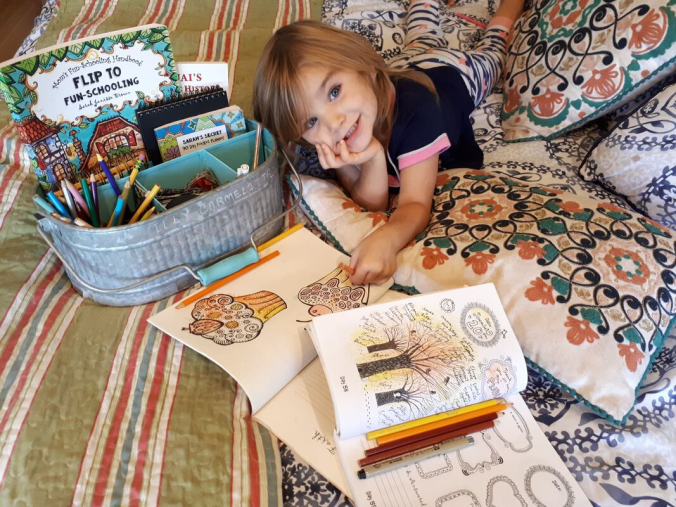
The first key to inspiring a child to read is to find out what the child wants to learn about and be attentive to what he is passionate about. Provide books on ALL levels about those topics. Look at the books together, and use books with a Fun-Schooling Journal. Allow the child to do a lot of drawing in the Fun-Schooling Journal if they can’t write, and please do some of the writing for him or her while the child watches and dictates (writing for your child once a week is enough).

The second key is to model a love for reading real books and writing on real paper – in front of your child – that’s what Mom-School books are for. When a child sees a parent reading and writing (not on a computer) they automatically desire to do it too. The brain is wired to give children a drive to do what adults do. (One big problem with classrooms is that all the kids are the same age, and kids are not getting an example of how people learn at a higher level.)

Curiosity will drive the desire to read, and the brain will begin to wire itself to read, write and spell. When a child is curious about reading they are going to learn quickly and efficiently. When a child feels the need to read, they WANT to learn.

When you try to force kids to read, write, and spell before they desire to do it naturally you are going to face a constant struggle. If the child desires to learn, they are going to be active in the learning, and actually teach themselves – it’s beautiful and joyful.

So, precious homeschooling mom, if your eight year old can’t read, don’t worry, just remember the two keys!

His Story: The Musical

Most people didn’t believe me when I told them my teenage daughter wrote, composed, and professionally produced a full-length musical. Now I tell them that as a young adult, she’s seen her music workshopped and produced in New York City by a Broadway Production Team.

This child was profoundly dyslexic as a little girl- we thought she might never be able to read

Overcoming Dyslexia and Pursuing Her Passions

How does a child with severe Dyslexia go on to write a musical? I need to rewind a bit and tell you about the life of Anna Miriam Brown. She is my second of 15 children. Even before I had children I knew would homeschool. Anna’s older brother started reading with ease at age three. I figured she would follow suit and teaching her to read would be quick and easy. Learning to read was anything but easy for her.

We tried reading program after reading program. Nothing stuck. One day in frustration Anna said she was never going to learn to read and she didn’t need to anyway. She wanted to be an artist and a mommy so she wouldn’t need to read much. We came to realize she had Dyslexia and would not learn in the same way as my oldest. I started to come up with a way to help her learn to read. I created art games for her that incorporated letters and basic reading. You can read more of the story in the article about Dyslexia Games. 

These games worked and my eight-year-old was able to read. My husband and I like to say that Anna was born dancing. She’s always loved music and watching musicals. Her primary focus in school has been music and she began composing songs at a young age. This passion for music has grown as Anna has become a young woman. (click here to read the story of His Story!)

Dyslexia Games: The “Brass Tacks”

Three Series of Dyslexia Games

Anna was young when I created Dyslexia Games. Older kids with Dyslexia felt the games I’d created were too easy. I set to work at creating more advanced games. These were helpful both for Anna as she grew and for older children.

Series A is best for children ages 5-8. It can also be used by older children who are profoundly Dyslexic. This series is primarily art-based and introduces a bit of writing and spelling. 

Series B for children aged 8-12. The art-based games become more advanced and more reading skills are required. We also include spelling and copywork in this series.

Series C is for ages 10+. We continue with intricate art-based games, add in some math, and work on cursive writing skills. 

Not Only for Dyslexic Kids

Families began introducing their early readers to series A- regardless of if they showed signs of Dyslexia. Parents realized they made learning to read fun and engaging and that children thrived. Older kids saw Dyslexic siblings working on series B and C and wanted to try them out. It became apparent these games were not only helpful for Dyslexic kids. 

We’ve heard from thousands of families who share remarkable stories about the benefits of Dyslexia Games in their homes. Parents have used Dyslexia Games with:

  • ADHD/ADD kids to help them focus and relax
  • Asperger’s 
  • Autism 
  • Dysgraphia 
  • Dyspraxia 
  • Non-Verbal learning disabilities
  • Visual Processing Disorders
  • As “brain breaks” before working on a more focused/difficult task
  • To de-stress and relax a kid when they were frustrated
  • For relief from Brian Fog
  • To help develop executive functioning skills 
  • Memory support 
  • And more!! 


This was certainly not something I ever expected. At this point, we think we’ve had about as many non-Dyslexic kids use Dyslexia Games as those with Dyslexia. Especially series A for new readers. I began to incorporate pages from these games into some of our Fun-Schooling journals and students have loved having them there.

Click here to continue reading.

All About Dyslexia Games!

“She’s almost 9, why can’t she read yet?” After yet another day of watching my daughter Anna struggle to read, I expressed my frustration to my husband. We would eventually come to discover she was Dyslexic. I watched the light go out of her eyes and her love of learning begin to die out. This was something I knew I couldn’t let happen. The journey to help my daughter with Dyslexia would end up helping thousands of adults and children. 

Dyslexia Statistics

Dyslexia is not a struggle unique to Anna. An estimated 20% of children are Dyslexic. The numbers seem to be growing. It’s hard to know if this is because of more awareness or another reason. Regardless, you know and interact with many people who have Dyslexia. Some children will “outgrow” Dyslexia while others will be lifelong Dyslexics.

Dyslexia Games Creation

My quest to help my daughter kept ending at dead ends. None of the products for Dyslexia worked for her or fit our family. I began to think about how Anna noticed b/d/p/q looked exactly the same. As I thought through ways to help her, I turned to her passion- art.

I was homeschooled myself and struggled in school. It’s likely I would have received an Asperger’s diagnosis myself. Awareness of Asperger’s was much lower when I was growing up than it is now so I was overlooked. One of the gifts of Asperger’s is the ability to think outside the box and be creative. Nobody knows their child better than their mother. I knew the answer to helping my daughter learn to read was one I could find.

One afternoon I sat down and started to draw. As I drew, I incorporated letters and words into my artwork. I wanted to see how Anna would respond to words and letters if they were presented as art instead of as a bunch of words on a page. I created puzzles for her to complete and pictures to copy. After I had a few done, I handed them over to her.

Anna loved them and eagerly completed them. But would they help her Dyslexia? After completing several more, she began to read! I made an entire set with different games and activities. Her reading ability increased and she was soon an avid reader who loved to read. Plus she no longer had any symptoms of Dyslexia.

We began selling the PDF version to print at home on our website DyslexiaGames.com and had physical copies printed and shipped by a local print shop at first. When we published Dyslexia Games Series C we switched from the local Print Shop to CreateSpace to drop-ship our books for us.  We also listed the books on Amazon as well. Thus, Dyslexia Games was born. 

Today Dyslexia Games have been used by thousands of children worldwide. We have families on every continent (except Antarctica!) and in dozens of countries. Dyslexia tutors, therapy centers, and schools are using the games with results unlike anything else out there. 

With this post, the journey began…

The Fun-Schooling Story: The Branches of The Thinking Tree Spread Out!

What The Thinking Tree Offers

As we’ve grown our tree has branched into several different offerings. Today we have six “branches” on our Thinking Tree. 

Fun-Schooling Journals consist of our core journals, the first journals we created. We also have dozens of smaller “single subject” journals on standard school subjects like Language Arts, History, Math, Science, Art, and Geography. Single-subject journals on “elective” topics have also been created such as Dance, Foreign Language, Animals, Sports, and even Minecraft! There are about 300 Fun-Schooling Journals.

Dyslexia Games is our art-based Dyslexia therapy program. It was created a few years before the first Fun-Schooling journal. There are three series for different age groups. Throughout the years we have found it helpful for students with ADHD/ADD, Asperger’s, and other learning challenges too. Interestingly, we’ve also found children without learning challenges or disabilities benefit too. It helps children with creative thinking, problem-solving, handwriting, spelling, art skills, math, and more.

Click here to continue reading.

The Fun-Schooling Story: The Thinking Tree Grows!

The Thinking Tree Grows

At first, we weren’t sure any of “this” would catch on beyond our circle of friends. As we were contacted by families asking for journals with different themes, we knew something special had come. I got to work creating more journals. Each was based on the same concept with different covers and interior artwork to appeal to kids’ interests. These core journals became the foundational journal for Fun-Schooling families.


We named our new company The Thinking Tree when we published Dyslexia Games. My kids got involved in creating journals based on themes they were interested in and subjects they wanted to cover. I created smaller journals to use as an in-depth study on a single topic.

A Facebook page and group were started. We got the attention of a few Mom Bloggers who shared our journals with their audience. I added in Math and Spelling journals. Thinking Tree was invited to homeschool conferences. A few of our journals became available through Barnes and Noble. I created a series of Mom School journals so moms could pursue their interests and be a good example. Word kept spreading about our Fun-Schooling journals and I became an unintentional entrepreneur! 

The Thinking Tree grew by leaps and bounds during the Covid 19 lockdowns…read about it in this post!

Read the beginning of the story here!

Dyslexia Games FAQs


Dyslexia Games Level A

What are Dyslexia Games?

Dyslexia Games is a method of dyslexia therapy created by Sarah Janisse Brown to help children who struggle with symptoms of dyslexia, as well as ADHD, ASD, and other learning issues. The books use art and logic to “reprogram the brain” by gradually helping children shift from using the right side to the left to process letters, numbers, and finally, words.

 Which Series of Dyslexia Games should I order?

Choose the correct series based on your child’s age and reading level:

Series A: Ages 5-8 (for new and non-readers)
Series B: Ages 8-12 (for struggling readers)
Series C: Ages 10-adult (for spelling, speed, focus, and comprehension)

**For more details, please see the “Order” page at www.dyslexiagames.com

 Does my child need to do the books in order?

Yes. It’s important to start with Book 1 of the Series your child is using and to finish each book before starting the next.

 Can my child skip around in the book?

No. The pages should be done in the order in which they appear in the book as they “build on” the previous page.

 How many pages should my child do every day?

Your child should complete 2-4 pages a day. Start with 2-3 pages and add a 4th if they request it. Cut back if they become visually overstimulated.

 What should my child use to complete the puzzles?

It’s recommended that your child use a smooth, black pen, preferably a gel pen, to create a smooth transition between the printed logic puzzle and the child’s work.

 How does my child complete the puzzles?

Your child will use logic to determine what’s missing in each puzzle, then use a gel pen to draw in the missing parts or complete the patterns.

 Should I point out mistakes my child makes while working the puzzles?

Yes. Ask your child to look over the page carefully and see if they notice anything that needs to be done differently. This will encourage your child to look for their own mistakes. If they don’t seem to recognize that the puzzle(s) are incorrect, gently correct them by asking, “Do you think you should try doing it this way instead?” or something similar. If possible, print out a copy of the puzzle to work yourself (two if your child wants to redo theirs) and have your child follow your example.

 My child wants to erase and correct mistakes. How do they do this using a gel pen?

There are erasable gel pens now if there are concerns that your child will want to erase and correct mistakes. 5B pencils also work well.

 Should my child color the puzzles?

Once the puzzles are completed and missing parts are drawn, your child can color them if they would like.

 When should my child do Dyslexia Games?

While Dyslexia Games can be completed at any point during the day, many parents have their children do the games before beginning other school work as the puzzles help with focus and concentration.

 What subject is Dyslexia Games?

Language Arts primarily. It also includes art, math, creative thinking, problem-solving, and handwriting. 

 Should my child continue their current Language Arts curriculum while using Dyslexia Games?

If your child is using Series A, it is recommended they discontinue using all other Language Arts materials, including reading. Parents should read to their children often and if the child wants to try to read, allow them, but stop if it’s causing any stress or anxiety. 

If your child is on Series B or C, watch their stress level. Continue with your other Language Arts materials as long as it is not causing stress or increasing Dyslexia symptoms. Some kids need to stop using other LA materials, while others can use both simultaneously.

 If I purchase the printed books, do I also receive the PDFs?

No, PDFs should be purchased separately.

 Are there printed instructions?

Basic instructions are printed near the front of every book and PDF.

 Will I need to help my child with Dyslexia Games?

Sit with your child and give guidance for the first few pages if necessary. After that, your child should be able to easily complete the pages on their own as they tap into their creativity and problem solving skills. The puzzles are logic based, intuitive, and creative, so most children are able to work on them independently.

 What do I do if my child resists doing Dyslexia Games?

One of the best ways to get children to cooperate with school work is to be an example. Print out your own copies of the puzzles and sit down beside your child to work the pages with them.

 Are Dyslexia Games only for children with dyslexia?

Dyslexia Games are great for children of all ages (and adults) with dyslexia, ADHD, ASD, and other learning issues, as well as those without. We’ve had thousands of children with all kinds of educational needs use Dyslexia Games. 

 What skills does Dyslexia Games help with?

Dyslexia Games help with multiple skills including: letter recognition; reading; tracking; distinguishing left, right, up, and down; memory; focus; attention to detail; problem-solving; handwriting and fine motor skills; spelling; art; logic; and help to “wake up the brain.”

 How does my child complete the Word Hunt book?

Your child will go on a “scavenger hunt” and look through books, magazines, or around the house on cereal boxes, etc., to find words with the specified number of letters. If your child is struggling to find words or needs more creative ways to hunt for words, try taking the book along as you go for a walk, in the car, or to the grocery store or other shopping excursions!

The Gift of Dyslexia

the gift of dyslexia

If you have read this post about my own homeschooling journey, you know that I am dyslexic. It was very difficult for me in 1st, 2nd & 3rd grades in public school. I failed 3rd grade, but over the summer my mom used the Narnia books to teach me to read.  Once I could envision the words as I sounded them out, I began to read. I felt like the words would swim on the page if I couldn’t visualize a picture in my mind.  At first I tried to think a picture for each word, but with Narnia I was able to visualize the whole story as a movie. My mom read the first part to me, and when I was really absorbed she told me I had to read it myself to find out what would happen next. 

I began homeschooling at age 13, and we did Library Based – Delight Directed Learning for the first year.  It was wonderful.  Then my parents got a tax return and bought a bunch of Abeka, Saxon and Bob Jones University Curriculum.  I lost the joy because it wasn’t fun and it brought back the challenges of dyslexia.  Later we started mostly un-schooling, but with a little more structure.

In high school, I had a grammar curriculum, a government and economics curriculum, and Spanish videos. Everything else was my choice, and I loved it. I majored in art, nutrition, architecture, and brain development all through high school. I always struggled with writing, but my mom encouraged exposure to a lot of poetry, copying poetry and scriptures, and reading biographies. I did a lot of creative writing in my homeschooling journals that I didn’t share. I was ashamed of my spelling.  Later we got a computer and spell check helped a lot.

When I was in 12th grade I accepted a job as a newspaper reporter and photographer. It really helped my confidence. I never wanted that job, but I wrote a story and took some photos about something interesting that happened in my neighborhood and gave it to the local paper. They published my story and offered me a job. All the Ds and Fs that I got in elementary school made me believe I would never have what it take to be a writer, so I thought I would be an artist. Secretly I was filling my journals with stories and poems, but I would have died if anyone would have found them and read them…I knew I couldn’t spell, but I loved writing. It helped me process my thoughts and feelings and ideas. Having the job as a reporter gave me confidence to speak up with my writing and open myself up to share with others.

Don’t feel like dyslexia is a limiting factor for your child. Do what you can to help them overcome the problems, but don’t think that dyslexia will keep them from being anything they want to be.  I am a good writer because of dyslexia. Dyslexics are storytellers. When they tell stories and create stories and reflect on memories they create whole worlds in their minds and think 1000 times faster than people who think with words.

I created Dyslexia Games for my daughter Anna.  She was a lot like me. BUT she was homeschooled, from a young age, so I could customize her education. I allowed her to major in the arts, and let her enjoy and direct her own education.  She couldn’t read or write before she was nine.  I was determined to use art and logic (her gifts) to teach her reading, writing, and spelling. But I waited until she was motivated. What motivated her to want to read? Yes, she was embarrassed at church, and constantly humiliated by relatives. That wasn’t her main motivation. She wanted to communicate and research and read a comic book, but she couldn’t. It was really sad because for a long time she tried so hard. We used 100 Easy Lessons and had a private tutor, she went to a Kumon learning center. Nothing worked.

That’s when I began trying the pattern games and the “what’s missing” art games that you see in Dyslexia Games.  I created about 100 little games with hidden letters and symbols.  Within 3 months she could read. She still had trouble with spelling.  But she would fill countless journals with her secret stories, songs and poems.  Now she is a singer and songwriter.

When I realized that she had a gift and desire in the area of songwriting I didn’t discourage her because of her dyslexia.  I got the best teacher I could find – Christine Dente from the band Out of the Grey. Anna’s lessons eventually inspired our “Singer and the Songwriter” Idea Book.   Anna has set the “Book of Matthew” to music and has produced a 30-song musical.  She still gets tired of writing so we uses a voice to text app. And that works for her. 

I shared this just to encourage you who feel like dyslexia can hold your child back, it is such a gift–it’s just that kids with dyslexia have a different timeline for developing skills.  Dyslexia Games can speed up the process of helping a child to read, write and spell… without frustration and without compromising creativity.  We focus on the gifting of the dyslexic mind, not the weak areas.  Trying to teach a dyslexic child phonics is like trying to force a left handed child to write with the right hand just because 80% of people are right handed. Dyslexic people learn differently and have talents that will amaze you. Just don’t expect them to be able to excel in reading, writing and spelling before ages 10 -13. In the teen years, with self motivation they take off and surpass others if given the right tools. (click here to continue reading)

How Your Child Thinks: The Inventors (Part 3)

visual thinkers inventors creators

The visual thinkers of the world were created to be the designers, inventors, the artists, the musicians, the sailors and explorers. We say they have a problem with obedience and respect or we call it Dyslexia, Asperger’s Syndrome or ADHD. We try to tame them. Honestly, we have failed them . If a child is failing in his classroom, it is the classroom that failed the child. The child is not the one with a problem just because he learns differently.

The child must be set free to be the inventor, the artist, the dancer. So who will teach the inventor? Who will train the artist? The child must become his own teacher, and his parents and teachers must become his students, to learn from him, to understand him, to realize that he has within him the power to become great. We need to discover how to help him become who he was meant to be. We must accept that it may never happen in a desk, in a classroom and behind a pile of textbooks, even if you give the child medication and take away his crayons. Do you want to be the one to take away Albert’s compass, Benjamin’s kite, or Leonardo’s paintbrush or little Thomas Edison’s mirrors?

What is the solution for the child who fails in the classroom? Set him free from the classroom. Ask the child what he wants to learn about. Ask the child what he wants to do. Take the child to the book store, take the child to the art store, take the child to the beach, the forest, the ruins of a castle. Give him pets and let him catch lizards. Read to him until he learns to read to himself. Search for learning materials that captivate the visual mind–things like compasses, clay, mirrors, and paintbrushes. Let him sail, play instruments, and dig in the dirt. Let him take things apart and give him colored pencils. Let him watch people at work doing all different things in the world, take him to the kitchen, take him to an art studio, take him into factories and show him how to use sewing machines, instruments, scroll-saws, and tools. Let her dance. (to continue reading click here)

A Fun-Filled Homeschooling Plan for Busy Parents and Active Kids

My Real-Life, Home-Learning Plan that is simple for parents and delightful to kids! Created by me, a mom who is currently Homeschooling 10 of her 15 Kids!

1. Logic Games2. Read Favorite Books
3. YouTube Tutorials
4. Nature Time
5. Online Math Games or Serious Stuff
6. Kitchen Time
7. Spelling Games
8. Complete 5 Workbook Pages or 5 Fun-Schooling Journal Pages
9. Play Outside
10 Art & Drawing
11. Just Dance
12. Chores
13. Online Games (a reward for chores and school)
14. Family Time and Board Games
15. Movie Time
16. Music Practice
17. Games for Dyslexia: DyslexiaGames.com
18. Fun Homeschooling Curriculum: FunSchooling.com
You can do these activities in any order, but Movies and Online Games should be close to last.