I want the share inspiration and encouragement that is helping me.
Here’s a talk from Nancy Campbell at Above Rubies, that explains the hormone Oxytocin, the “peace hormone” and how to tap into its power to reduce stress and anxiety, and give you a feeling of peace!
Click here for a post on “Tips for Reducing Stress, Media, and Clutter”!
When it comes to parenting, you never quite know what challenges you’ll face. For me, one of the biggest surprises came in the form of dyslexia. My oldest daughter, Anna, is the first one that we discovered is dyslexic, and it’s really an amazing story!
My first son, Isaac, was a natural when it came to letters and reading. He was already reading by age five, so I figured I’d use the same approach with Anna. But Anna was different – a free spirit who could never sit still. At four, she showed zero interest in reading, so I decided to step back and let her explore her own interests, like drawing and nature.
By the time Anna turned six, I felt it was time to focus on helping her learn to read – but it quickly became apparent that something wasn’t clicking. Phonics made no sense to her. She would get upset, she would get angry, she would cry. She would get one word correct one day, and then, the next day, she’d forget it. We tried again when she was seven, even bringing in a teacher, but the struggle continued.
As Anna approached eight and still couldn’t read, I started to worry. With five or six children at that point, my in-laws began suggesting that I might be too busy with the younger ones to teach her properly. It was heartbreaking when, at nine years old, Anna told me she didn’t care about learning to read because it was too hard for her to differentiate between letters. She declared she’d just be an artist and a mom instead.
I remember sitting there, stunned by her words. After a moment of reflection, I gently told her, “Anna, God wouldn’t have given us the Bible unless he was going to give us the ability to be able to read it.” It was then that I realized we needed a different approach. Anna was a real problem-solver, so I decided to try and outsmart her reluctance to read by creating something that turned reading into a problem-solving challenge.
Click here to find out what Sarah did next (and access some free resources)!
Please note that we request for Amazon to mark down journals to a specific price for a certain length of time but they don’t always get marked down/ stay marked down the whole time. If there’s something you really want, make sure to grab it soon!
We often hear moms saying they don’t have the time. Moms are busy. We get that! Which is why we think Mom School is especially important. It’s an opportunity for you to feed your mind, set an example for your kids, and unwind.
Consider this- even one page per day is enough for you to fill multiple Mom School journals in a year. Stop scrolling- you have time for one page a day. Even if you only get one page for 180 days- that’s a full Mom School journal.
There is also a big mental impact of “should-ing” yourself and feeling like you’re not accomplishing something. Think about how great you’ll feel at the end of the year when you’ve filled a journal or two with only one page per day! 15 minutes or so is all you need. You’ll have learned new things, helped your brain think in new ways, and balance your thoughts.
Our journals are designed to help decrease stress and bring more ease to your days. Give yourself permission to take time for yourself. Moms struggle with this.
We suggest 4-6 pages per day most days of the week for full Mom School. Working up incrementally is the easiest way to build a habit. Start with one page. In 6 weeks, start doing two; 6 weeks after that add a 3rd- no need to jump all in right away.
If you can get someone to hang with the kids or a program for them to go to a few hours once a week, give yourself a regular Mom School date! Pull out your secret stash of snacks, make your favorite drink, and spend time learning something new. It’s tempting to binge-watch your favorite shows when you get a moment alone- there’s nothing wrong with that- try starting with a bit of Mom School first.
ALL Mom School PDFs are 50% off! – INCLUDING Brain Games and the Bird Watching Journal Mom School Handbook Paperbacks are $15.75 Bird Watching Paperback is $12.50 Coffee Time Paperback is $17.50 Homeschooling Handbook Paperback is $17.50 All Brain Games Paperbacks are $10 or less 90-day Pocket Planners are all $5 or less We hope this helps you on your Mom School journey!
May is Mom School Month, and we are excited to share more tips, resources, and ideas with you. Make sure and join us at our main Fun-Schooling group for great content, giveaways and discounts, and encouraging discussions! And our Mom-specific Fun-Schooling group has a regular giveaway each week! Hope to see you there!
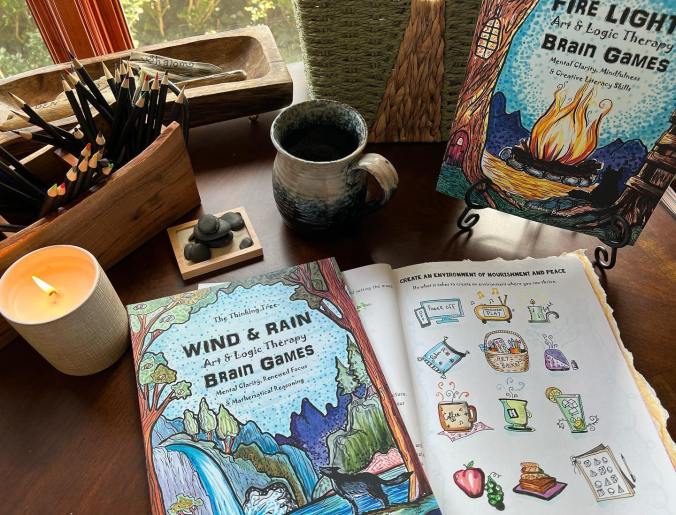
Dyslexia Games is designed around the beautiful and creative dyslexic mind.
It uses the gift of art, the creative genius, the ability to see through the mind’s eye to complete patterns and solve puzzles. The games focus on the dyslexic gifts and talents as the symbols, letters, words and poetry are added to the activities- step by step, little by little.
The idea is to light up the dyslexic mind that the student engages in art and logic; the strongest part of the mind is activated as the symbols are reintroduced. The idea is for the stronger areas of the mind to engage in the process of symbol identification.
I would recommend reading “The Gift of Dyslexia” to really understand what people with dyslexia are brilliant and how to engage their brilliant minds while reintroducing literacy.
Many dyslexia therapies just focus on “kindergarten type phonics” over and over and over. This type of therapy offended my brilliant dyslexic daughter.
I wanted a reading program that would respect the fact that she was an artist, a thinker, a storyteller, a creative. And that is why she thrived with Dyslexia Games.
Here are some wonderful testimonials:
“We’ve almost completed series B. My sons are more confident to try spelling and for the most part I can actually figure out what they are trying to spell. These are huge steps for these boys that could barely put pencil to paper because of the stress. Our speech lady hadn’t seen us since Covid. And I know that’s long but we really haven’t done anything for spelling since that time except these books. And the speech lady was floored at how much they had improved. One of them doesn’t even qualify for speech/language right now (which was going to be for focus and help with dyslexia). These books are the only thing I can think of that have made the difference.” Tina Perez Glenn
“These books were a huge game changer for us. We went through Dyslexia Games a few years ago with my oldest and I truly believe they really helped. There was some serious struggle with the first few books while he got the hang of it, but he stuck with it and we noticed a big difference. He also built his confidence back up which was huge for us. Then we discovered their curriculum journals and have used them ever since. Both my boys enjoy them so much! I have my own books to work in alongside the kids and it really sets the tone for learning. I also love the supportive community and company itself.” Leanne Nattress
“Two of my sons and myself use the Brain Games and Dyslexia Games books. My profoundly dyslexic kiddo is reading after less than a year using these books! My dysgraphic kiddo is writing FOR FUN. And, I have noticed that if I do 2-3 pages a day, my brain fog and using the wrong words is a lot better!” Stephanie Ann Goetsch
“We have used the Dyslexia Games and it made a huge difference for my youngest son. We had tried more traditional therapy and he fought it tooth and nail, but not the dyslexia games. We are currently using Math Craft and like it as well.” Amanda Murray Griffey
“Our daughter is a high school junior. She was exasperated as we tried one thing after another, trying to find something that would click with her brain, as she deals with dyslexia and Asperger’s. Dyslexia Games was the solution. Having everything available in Dyslexie font was huge for her. As she’d faithfully do 2-3 pages a day, I began to see changes not only in her reading and writing, but also in her ability to organize and perform tasks in sequence (both are challenging for kids like her). It has boosted her self confidence so much! We love the journals generally and use not only Dyslexia Games but many, many other Fun-Schooling journals almost exclusively for her school now. I also do Brain Games Art & Logic Therapy alongside her which has helped me with Covid fog/fibro fog while inspiring her by my example. Win-win! What’s not to love???”Diane Heeney
We all have moments and seasons that we look back on and wonder how we made it through. Enjoy one of my Facebook posts from a decade ago…
I found a journal from 2004 – Moms – you need a laugh… I had a made a list of all the “toddler trouble” Anna got into in one week.
The Setting: Rachel is one month old. Estera is 1 1/2, Anna is 3, and Isaac is 5.
Anna’s Top 20 for the Week of May 5th 2004:
1. Anna mixes ice-cream, sprinkles, popcorn and cat food.
2. Anna plays with a slug until she kills it.
3. Anna gets baby out of swing all by herself.
4. Anna glues paper to the floor.
5. Popcorn dumped all over floor.
6. Anna & Estera put celery in the potty.
7. Anna dumps Wheat Chex into bath tub.
8. Anna makes art with peanut butter.
9. Anna cuts her hair.
Remnants of an experiment…
10. Anna spreads glue stick all over.
11. Anna dumps the chalk twice and eats it.
12. Anna paints and colors everything but the paper.
13. Anna sprinkles poppy seeds all over the house.
14. Anna goes bug hunting.
15. Anna sneaks off with a plate of spaghetti, and decorates house with it.
16. I look out the upstairs window to see diapers scattered all over the roof – Anna?
17. Anna sneaks away with the popcorn popper and knocks over a large glass container, shattering it all over the laundry room.
18. Anna removes ink stick from a red marker. Anna fills a container with water, adds the red ink stick, makes red water.
19. Anna spills red water all over the house.
20. Anna gets the ice cream, all by herself.
What was I doing while Anna was making all these messes? I was nursing baby, homeschooling Isaac, recovering from birth, and cleaning up glass, wheat Chex, peanut butter, glue stick, chalk…
The saying is so true…”The days are long, but the years are short!” Cherish each moment you can. Today, Anna is a beautiful, talented, inspiring young woman. You will survive, and they will thrive. Stay faithful, mom friends!
Here are some ideas for how I try to turn a bad day into a good day.
1. Turn on “Just Dance” for the kids on YouTube.
2. Don’t try to do school as planned. Find a funny way to repurpose a page in a workbook or Fun-Schooling Journal. Let your kids turn the Nature Study page into a Zombie Study page.
3. Take a break from everything that is stressing anyone out.
4. Get out of the house, with or without kids. Preferably without. Haha!
5. Get out a board game or UNO. If you want the older kids to be busy for a long time offer a nice prize to the winner of the Monopoly game.
13. Ask husband to take a bunch of kids to a park. (If you are a single mom, reach out to grandparents or fellow mom friends for a swap play date…and then return the favor!)
14. Get everyone outside for Nature Study.
15. Make an early dinner.
16. Tell the kids that we will have a movie night if they get the house clean, and turn on the happy music while they work.
18. Send a group of older kids to the corner market to get ice cream for everyone.
19. Figure out how to turn tonight into a date night.
20. If all else fails, ask husband to put the kids to bed early. Then clean your room really nice, set out a treat, light a candle, turn on peaceful music, ask husband to bring the wine, lattes, or fresh squeezed orange juice. Be sure to sweetly ask husband to get the kids to bed while while you take a long hot shower. In this case HE WILL do what it takes to get the kids to bed early!
Anna was young when I created Dyslexia Games. Older kids with Dyslexia felt the games I’d created were too easy. I set to work at creating more advanced games. These were helpful both for Anna as she grew and for older children.
Series A is best for children ages 5-8. It can also be used by older children who are profoundly Dyslexic. This series is primarily art-based and introduces a bit of writing and spelling.
Series B for children aged 8-12. The art-based games become more advanced and more reading skills are required. We also include spelling and copywork in this series.
Series C is for ages 10+. We continue with intricate art-based games, add in some math, and work on cursive writing skills.
Not Only for Dyslexic Kids
Families began introducing their early readers to series A- regardless of if they showed signs of Dyslexia. Parents realized they made learning to read fun and engaging and that children thrived. Older kids saw Dyslexic siblings working on series B and C and wanted to try them out. It became apparent these games were not only helpful for Dyslexic kids.
We’ve heard from thousands of families who share remarkable stories about the benefits of Dyslexia Games in their homes. Parents have used Dyslexia Games with:
ADHD/ADD kids to help them focus and relax
Asperger’s
Autism
Dysgraphia
Dyspraxia
Non-Verbal learning disabilities
Visual Processing Disorders
As “brain breaks” before working on a more focused/difficult task
To de-stress and relax a kid when they were frustrated
For relief from Brian Fog
To help develop executive functioning skills
Memory support
And more!!
This was certainly not something I ever expected. At this point, we think we’ve had about as many non-Dyslexic kids use Dyslexia Games as those with Dyslexia. Especially series A for new readers. I began to incorporate pages from these games into some of our Fun-Schooling journals and students have loved having them there.
“She’s almost 9, why can’t she read yet?” After yet another day of watching my daughter Anna struggle to read, I expressed my frustration to my husband. We would eventually come to discover she was Dyslexic. I watched the light go out of her eyes and her love of learning begin to die out. This was something I knew I couldn’t let happen. The journey to help my daughter with Dyslexia would end up helping thousands of adults and children.
Dyslexia Statistics
Dyslexia is not a struggle unique to Anna. An estimated 20% of children are Dyslexic. The numbers seem to be growing. It’s hard to know if this is because of more awareness or another reason. Regardless, you know and interact with many people who have Dyslexia. Some children will “outgrow” Dyslexia while others will be lifelong Dyslexics.
Dyslexia Games Creation
My quest to help my daughter kept ending at dead ends. None of the products for Dyslexia worked for her or fit our family. I began to think about how Anna noticed b/d/p/q looked exactly the same. As I thought through ways to help her, I turned to her passion- art.
I was homeschooled myself and struggled in school. It’s likely I would have received an Asperger’s diagnosis myself. Awareness of Asperger’s was much lower when I was growing up than it is now so I was overlooked. One of the gifts of Asperger’s is the ability to think outside the box and be creative. Nobody knows their child better than their mother. I knew the answer to helping my daughter learn to read was one I could find.
One afternoon I sat down and started to draw. As I drew, I incorporated letters and words into my artwork. I wanted to see how Anna would respond to words and letters if they were presented as art instead of as a bunch of words on a page. I created puzzles for her to complete and pictures to copy. After I had a few done, I handed them over to her.
Anna loved them and eagerly completed them. But would they help her Dyslexia? After completing several more, she began to read! I made an entire set with different games and activities. Her reading ability increased and she was soon an avid reader who loved to read. Plus she no longer had any symptoms of Dyslexia.
We began selling the PDF version to print at home on our website DyslexiaGames.com and had physical copies printed and shipped by a local print shop at first. When we published Dyslexia Games Series C we switched from the local Print Shop to CreateSpace to drop-ship our books for us. We also listed the books on Amazon as well. Thus, Dyslexia Games was born.
Today Dyslexia Games have been used by thousands of children worldwide. We have families on every continent (except Antarctica!) and in dozens of countries. Dyslexia tutors, therapy centers, and schools are using the games with results unlike anything else out there.
As we’ve grown our tree has branched into several different offerings. Today we have six “branches” on our Thinking Tree.
Fun-Schooling Journals consist of our core journals, the first journals we created. We also have dozens of smaller “single subject” journals on standard school subjects like Language Arts, History, Math, Science, Art, and Geography. Single-subject journals on “elective” topics have also been created such as Dance, Foreign Language, Animals, Sports, and even Minecraft! There are about 300 Fun-Schooling Journals.
Dyslexia Games is our art-based Dyslexia therapy program. It was created a few years before the first Fun-Schooling journal. There are three series for different age groups. Throughout the years we have found it helpful for students with ADHD/ADD, Asperger’s, and other learning challenges too. Interestingly, we’ve also found children without learning challenges or disabilities benefit too. It helps children with creative thinking, problem-solving, handwriting, spelling, art skills, math, and more.


 ALL Mom School PDFs are 50% off!
 Mom School Handbook Paperbacks are $15.75
 Bird Watching Paperback is $12.50
 Coffee Time Paperback is $17.50
 Homeschooling Handbook Paperback is $17.50
 All Brain Games Paperbacks are $10 or less
 90-day Pocket Planners are all $5 or less