Thirteen years ago, all the kids were 12 and under and I organized EVERYTHING. Now that they are all ten and up I organize very little moment by moment activity, I just make sure the basics are covered. Running a home with 8 kids under 12 was a very different season. Above is our “chore chart” for that season (see others below!). It was a great way to motivate and keep things on somewhat of a schedule. So funny that Esther at age 10 was going to the coffee shop for two hours a day. We lived on Main Street and she loved having her chill time there.
This was my actual Home-Learning Plan five years ago. It is simple for parents and delightful to kids!
Logic Games
Read Favorite Books
YouTube Tutorials
Nature Time
Online Math Games or Serious Stuff
Kitchen Time
Spelling Games
Complete 5 Workbook Pages or 5 Fun-Schooling Journal Pages
Play Outside
Art & Drawing
Just Dance
Chores
Online Games (a reward for chores and school)
Family Time and Board Games
Movie Time
Music Practice
Dyslexia Games You can do these activities in any order, but Movies and Online Games should be close to last.
For chores, we would create new schedule once every 3 or 4 months. Everyone liked knowing exactly what areas of the house they were responsible for.
Chores are largely about teaching life skills and serving others. This journal can help!
In our family of 15, we don’t view k-12 education merely as a stepping stone to college. Our kids don’t even know what “grade” they are in half the time.
Instead of focusing on traditional academics, we see childhood as an exciting opportunity for our kids to begin crafting real-world skills centered around their passions.
As a homeschooling mom I get to create an environment for learning that inspires each child in the pursuit of their unique dream or calling, while exploring fulfilling options for a career.
Ages 2-5 From the outset, we introduce our kids to stories of passionate people who never give up, do great things and solve problems in the world. We are laying the groundwork for a life where work and calling intertwine. We love to read about people and find out about the jobs of the people we meet, from the high call of being a mommy or daddy, to the world-shaping influence of authors, political figures, heroes, artists and inventors.
I remember when my son Joseph was five, when he would meet someone new he would say “Hi, my name’s Joseph, I’m a scientist. What are you?”
Isaac’s bracelet-making and sword crafting were not just about making money but about igniting his creative and business acumen.
Leah, Ember, and Lilly’s craft sales at festivals were lessons in art, economics, and teamwork.
Rachel’s book reselling taught her about value, negotiation, and her love for literature.
Esther’s bath salts business combined chemistry with marketing, all while following her interests.
Ages 9-12 We deepen their engagement with their passions:
Providing resources like an aviary for Laura who is passionate about birds or a piano for Joseph who is gifted in music – these gifts allow them to live their passions daily.
We emphasize learning by doing, ensuring that education is not abstract but connected to real-life applications. Why learn something from a book when you can do it in real life? As homeschoolers we are not limited by the walls of a classroom!
Ages 13-20 Here, we move from exploration to mastery:
Investing in their vision on their 13th birthday We provide them with real tools to build their dreams, whether they lead to a career or a calling.
Skills taught are those they’ll use in their chosen paths, like marketing, leadership, or specialized knowledge.
We limit distractions to keep their focus on what truly excites and fulfills them. No phones until they are ready to run a business that requires it. They have to pay for their own phone, and we parents put filters on the device to keep the kids safe and productive.
In every era of rapid technological advancement, humanity faces a crossroads. Today, as AI and robotics threaten to replace human labor on an unprecedented scale, we are confronted with deep questions: What will happen to our jobs, our purpose, and our value? How will we spend our time, our energy, and our lives?
This isn’t the first time we’ve faced such a dilemma. A striking parallel existed in the 1950s when household technologies revolutionized daily life. Tasks that had once demanded weeks of effort—gardening, raising meat and eggs, canning food, sewing clothing—were suddenly replaced by mass production and modern appliances. The washing machine, refrigerator, vacuum cleaner, and telephone transformed the role of the housewife, freeing up vast amounts of time.
For many women, this was both liberating and disorienting. The work that once defined their survival and value within the family became unnecessary. They were no longer the primary producers of food and clothing, and their contribution shifted. Many entered the workforce or turned to consumerism and leisure.
But this “freedom” came with unforeseen consequences. Fast-forward 75 years, and we see a society grappling with obesity, mental health crises, loneliness, and fractured families. The very technologies that promised to make life easier have left many people without a sense of challenge or purpose.
Now, as AI advances at breakneck speed, we are entering a new era of disruption. Entire industries may be transformed or rendered irrelevant. What will happen when robots and technology handle most of the tasks that once filled our days? Will humans—like the 1950s housewives—find themselves with too much time, too little purpose, and no meaningful challenges?
Humans need to be challenged. We thrive on purpose, on working hard for something that matters, and on the satisfaction of overcoming obstacles. If AI takes over the bulk of our work, the question is not “What will we do with our time?” but rather, “How will we use it meaningfully?”
Click here to consider some answers to these questions, and discover some actionable points for you and your family.
What is a natural interest? A natural interest is an area of life that you’re drawn to! For a lot of people, they might call this their hobby or side project. Natural interests can cover a vast variety of subjects – from a specific animal to the overarching act of reading, to drawing with charcoal or recording/writing music! Natural interests are our callings. So how do you spot this in your child from an early age?
Identifying your child’s natural interests can help guide their growth and learning! Here are some simple ways to spot what excites and intrigues them:
Observe Their Early Play: Pay attention to the activities they choose most often — whether it’s building, drawing, or imaginative play! These can reveal their passions, such as an interest in architecture, fashion, or writing creative stories!
Follow Their Questions: The “why” and “how” questions they ask can point to what they’re curious about, like science, nature, or history!
Notice What Captures Their Attention: Take note of what they focus on for long periods and what they ask to learn more about — this shows what they’re naturally drawn to!
Encourage Exploration: Provide different activities (arts, sports, books) and see what excites them the most! Giving them a variety of topics to learn about can help you notice which ones they focus on the most! By observing your child’s play, questions, and actions, you can help nurture their natural interests and encourage their growth!
Learn more about preparing your child for their future calling/career here.
Find journals for every possible area of interest imaginable by clicking the image below!
Please note that we request for Amazon to mark down journals to a specific price for a certain length of time but they don’t always get marked down/ stay marked down the whole time. If there’s something you really want, make sure to grab it soon!
Give kids control to choose what they want to do and when they want to do it
Montessori students know what needs to be accomplished in a designated amount of time and are given the freedom to complete their tasks in any order they choose
Montessori classrooms rotate out activities/works
Can rotate single-subject journals and complementary materials
Store them on a low shelf/table for easy access
Nature study, Life Skills, character development, and the arts are a big part of Montessori
We have journals for all of those!
Pair them with hands-on life experience
Use Montessori materials like sandpaper letters, Montessori math manipulatives, and motor skills frames/toys alongside the journals
Wooden puzzles!
Popular in Montessori and go great in a Fun-Schooling basket
Nomenclature cards/ 3-part cards
These are used to introduce new words and teach different subjects
Would work great along with journals, especially with vocabulary building pages
Fun-Schooling journals can be used by a wide range of ages and Montessori classrooms are multi-age classrooms
Put together a multi-age group of other homeschoolers to go through a journal together
Montessori teens choose an area of focus and engage in hands-on in-the-field study on that area of focus
Just like choosing a major!
Montessori values teaching independence and equipping kids with skills to thrive on their own
Our research method and journals are set up with this same goal in mind
Watch a flip-through of some of our Montessori-friendly journals here:
The Montessori Method was founded by Maria Montessori
An Italian educator in the late 1800s/early 1900s
She was the first female Italian doctor
Advocated for women’s rights and child labor laws
Studied child development and learning before opening her own school
She researched educational approaches and philosophies throughout the ages and studied children in-person to create her approach
Pulled heavily from the work of Jean-Marc Itard and Edouard Séguin
Main Focuses of a Montessori education
Very hands-on and sensory focused
The Montessori schoolroom engages all the senses
Activities are referred to as “works”
These works will engage multiple senses at a time
The environment itself is kept low-sensory and very tidy- everything has a place and is always put back in that place. Only one work out per child at a time. Known as a “prepared environment”
Lessons are incredibly tactile with things like sandpaper letters, counting beads, building blocks, and lots of manipulatives
Play is work- and children should not be interrupted while working or playing. A big focus is on letting them do things at their own pace with full concentration
Everything is adapted to be child-size and child-friendly
Works will be put out on low shelves, kid-size tools are made readily available and presented to the child from a young age, kid-size chairs, tables, etc.
In the kitchen, kids will have their own set of kid-size cooking items and a special stool to be able to stand up at the counter
Kids are given real glasses instead of plastic and “real” tools that are simply child size
Taught to work with careful consideration and attention to detail
Big focus on Life Skills
Taught from a very early age and children are encouraged to be independent from toddlerhood
Excellence in completion and attention to detail is a bit part of learning Life Skills
Self-care, cleaning, cooking, sewing, and other basic Life Skills are taught beginning in toddlerhood
Gardening and farm work are often a part of the daily school tasks
Natural materials
Plastic is almost never found in a Montessori setting
Wood, fabric, and glass are the primary materials found
The main core educational subjects are taught along with a big focus on art, citizenship, independence, nature, and engaging in the community
Other tidbits
In a school, children are grouped with a wide age range- usually 2-4 grades all together
Self-directed learning lets children progress at their own pace
Still guided by an adult with each work very carefully introduced in a methodical way
Children then can work through things at their own pace and based on their own interests
There’s not usually a strict schedule of X subject at X time
Instead, children will know what they are expected to accomplish in a day and be given the freedom to complete their tasks in the order they desire
No screens until at least 4th grade
Age 0-6 is a key age for introducing concepts, life skills, and development
Some similar components to Waldorf and Charlotte Mason but starts academic instruction at a much younger age and is much more methodical
Stay tuned for our next post where we will talk about integrating the Montessori Method into your Fun-Schooling!
Kids need to know HOW to learn what they need when they need it.
Sometimes we fear learning gaps, but if a child knows HOW to research there will be no permanent holes because the child will be capable of learning on the go.
There is no way to prepare a child for what life and the economy will look like when they are adults.
Today’s standardized education is already behind.
It is research skills, creativity, character and resourcefulness that will insure potential for successful adult life.
Thinking Tree focuses on life skills, thinking skills, planning skills, being innovative, being creative, being resourceful, great character development, having excellent research skills, reading and writing skills and a strong work ethic. These things are NOT usually part of a standardized curriculum plan. You may worry that your kids will not be on grade level; but the skills that matter most are often overlooked and undervalued.
Joe does passion-based homeschooling. He is in charge of his education and uses Fun-Schooling Journals, Tuttle Twins Books and a lot of Usborne books.
Real life has no instructions. All children grow into adults who encounter situations and opportunities where no one explains what to do. We want our children to think and be innovative. Almost all normal schoolwork is based on following instructions and memorizing information. At our house we don’t do that.
When I created all of my homeschooling books I created them for my kids. I am specifically designing a method of learning to inspire thinking, problem solving and innovation. Because my kids have dyslexia and Asperger’s (like me), we are not going to follow a normal path. My kids would never make good employees so I don’t expect any of my children to be employees. I expect them all to have an awesome work ethic and to be business owners and managers of their own families and homes. The public system is training millions of children to be employees – who have a very watered down work ethic. I would never choose to hire common core kids. That’s not our goal, so we are traveling a unique path. Each child is unique and so we focus on their gifts and interests.
Now, they will learn to be good workers because I am giving them all opportunities to learn by working in the home and the family business, and they serve with missionaries and in church. When they volunteer, they really shine.
I never actually expected so many other people jump in and use my books, but I think that your children will really be blessed and your families will enjoy homeschooling with these methods.
I wasn’t creating school books that will help the children to fit into a mold that prepares them for “higher education”. SORRY! My goal is for my children to be innovative business owners with steady incomes by age 20, who do not need “higher education or an extended adolescence” to prepare for real life. If your child needs that, go for it! No shame! It’s all good! We need all kinds of people in the world. Just don’t plan your child’s education based on an antiquated view of what education should be.
Knowing our goals, I try not to waste my children’s time, brain space, and energy on schoolwork that doesn’t prepare them for real life. I am a bit of a rebel, and sometimes I worry that my kids might miss something… but they are proving me wrong. Whenever my teens need to learn something simple or complex, they get it done! They rarely ask for help anymore (unless they are trying to open a bank account, need a new computer, need an investor, or are filling out forms to become Amazon Associates).
Our kids are all excelling in their own way, developing their own talents and starting their own businesses – often before I even have a chance to show them how. They all have strong faith and family values.
One thing I have them do is read popular adult level books on marketing, business, and leadership. I also have them building websites and creating real books at a young age – check out our “Notebooks for Creative People” on Amazon. We don’t use textbooks, we always use well-written and interesting REAL books by passionate experts on every subject we want to study. We don’t just unschool, (though it works on many levels) because I really want to pass on my favorite books, family values, faith and traditions.
Sometimes I wonder what will become of all these creative thinkers and innovative children who adore my books. I would like to know what your children are passionate about, and how you are helping them to learn!
I have noticed that between age 11 and 14 every child begins to develop a deep interest in one or two specific areas. If we don’t discourage them they can become experts. If they don’t embrace that passion for a specific career at that point they often drift into a season of fog where they don’t feel like they have purpose. At that point many teens drift into rebellion, confusion or a feeling of being aimless and like their lives have no value. The kids who are encouraged to dig deep into their passion as a young teen develop a healthy and confident perspective. Even if they change “majors” they will never forget the skills they learned.
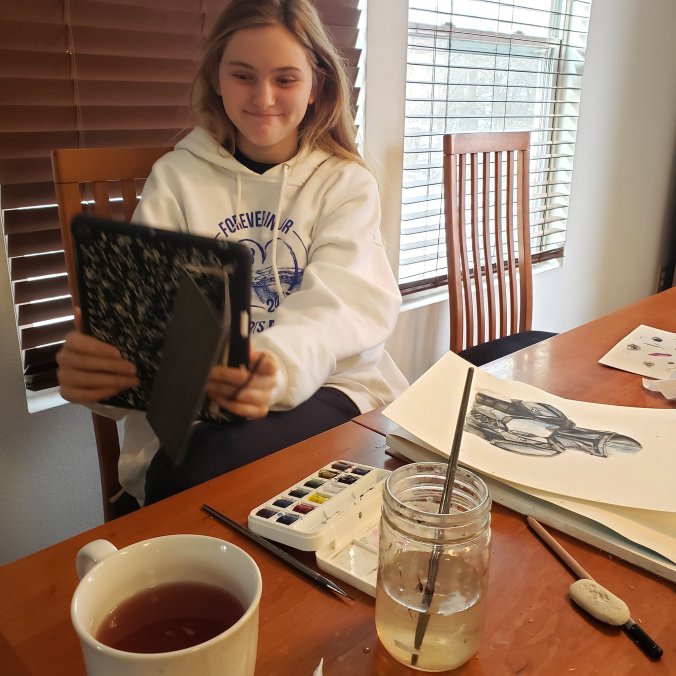
One of the most important ways we can invest in our children’s talents is by NOT distracting them or diverting their attention when they are focused on a project. I give my kids vast amounts of time to pour into their passions. Even if it means setting aside my preconceived ideas about what a kid should do and learn at their grade level. This is my daughter Susannah, she’s 14, and is focused on art.
Kids forget most of the information that they do not use, but once they learn a skill it is theirs for a lifetime. What is your child passionate about? What careers relate to it? Is it a topic that other people are interested in? If your child spends a few years becoming an expert in that area they will be able to build a portfolio, and have real life experience in that field. As an older teen they can volunteer to assist someone who is a professional in that field and get their foot in the door. Once they show their value, they can begin to be an important part of that business, so valuable that they will get a position working in that field. At this point, as a young teen, they need to focus on people skills, leadership skills, teamwork, and character building. I have seen many people take this path into the business world, where they end up doing what they love, and getting paid well for it.