Fun-Schooling + Wild & Free = a perfect match!

Years ago, I took the kids on a walk after breakfast. We didn’t have a plan—we just needed fresh air and sunlight on our faces. We sat under a tree and read poems, sketched in our journals, and shared apples from a basket. By the time we got home, it had been hours—and I realized something:

That was our whole school day.
And it was good.

Not good because it ticked off a list of academic boxes. Not good because it was planned or polished or even quiet. It was good because it was true. True to the way children learn best—through wonder, through movement, through meaningful moments that speak to the heart and engage the senses. It reminded me of my own homeschooling years, spending hours outside letting nature be my guide.

That’s the same kind of goodness I see in the Wild + Free community.

Fun-Schooling and Wild + Free were seemingly made for each other. Both are built on the belief education isn’t something that happens to a child—it’s something that flows from the child. It flows from their interests. Education is their environment. It is their questions. Their exploration. Following their own paths.

Wild + Free is about gathering in nature, embracing simplicity, and letting go of the pressure to perform. It’s about letting kids be kids—muddy, curious, barefoot, imaginative. It’s about motherhood that values connection over perfection.

And that’s exactly what Fun-Schooling was created to support.

Fun-Schooling is interest-led and delight-driven. It says yes to creativity and no to comparison. It turns the world into a classroom and the family into a learning ecosystem. When you combine that with the Wild + Free philosophy? You get something even richer. You get shared meals outside. Art inspired by the sunset. Science with a pond. Geography in your beautiful backyard.

You get memories.

You get a childhood worth remembering.

You get the freedom to let your homeschool life reflect your family’s values instead of someone else’s curriculum guide.

I’ve met so many Wild + Free moms over the years, and what I love about them is this: they are present. They are brave. They are willing to do things differently because they know what’s at stake. They’re not chasing test scores—they’re cultivating souls.

And if you’ve ever looked around at your family and thought, “We were made to do this differently”—you’re not alone.

You’re not wrong.

So let the kids get dirty. Let them spend whole afternoons building fairy houses and drawing maps and studying bugs. Read poetry under a tree. Pack a basket with books and snacks and take your lessons to the park. Say yes to beauty. Say yes to learning that feels like life.

Dive into nature study all you want. Let kids be kids. Don’t force away childhood one moment too soon.

Companion Journals for the Wild + Free Family
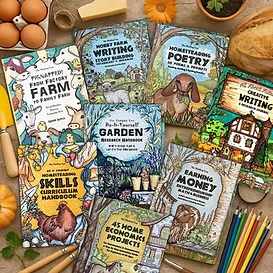
Back to Basics Homesteading & Farm Bundle– Nature study. Essential homestead and farm skills. Handicrafts. Economics. Writing. And more! Some of the journals are available individually as PDFs and all are available individually as Paperbacks as well.

Nature Study & Outdoor Science A Charlotte Mason-inspired nature study journal used by Wild + Free families around the world!

Core Journals– Seasonal core journals to cover all the major school subjects- and nature study in one place. Each has a fun seasonal and nature-inspired theme. Summer. Spring Girls. Spring Boys. Winter Girls. Winter Boys. Autumn.

Wilderness Adventure Handbook Essential wilderness survival skills presented in a fun way. Teaches outdoor safety, survival, wildlife skills, and more. A fun group study.
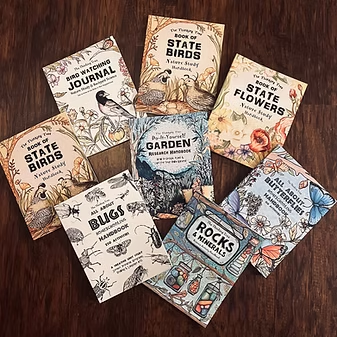
The Backyard Science Bundle-Our most popular nature study journals all in one bundle. The journals are available individually as PDFs and Paperbacks as well.


Read More-

Budget-Friendly Tips from Real Fun-Schooling Moms!
The Princess of Montgomery Woods
Fun-Schooling Lifestyle, Practical Tips & Reality 

How a Neuroscience Discovery Sparked Dyslexia Games: A Personal Reflection on Reading in the Brain

Over a decade ago, I stumbled upon a book that changed the course of my family’s journey—and eventually, the lives of tens of thousands of families around the world. That book was Reading in the Brain by neuroscientist Stanislas Dehaene. In it, he explains what happens inside the brain when we read—and what doesn’t happen in the brains of people with dyslexia.

The chapter that stood out to me most as a mother of dyslexic children was the one on dyslexia, but the chapter before it offered a key insight that unlocked everything for me. Dehaene describes the “letterbox” area in the left hemisphere of the brain—the visual word form area—as the hub where reading takes place in a neurotypical brain. But for people with dyslexia, this area is either inactive or extremely slow during reading tasks, which explains their deep struggles with recognizing written language.

But then came the breakthrough: brain scans of dyslexic individuals who eventually learn to read showed something amazing. Instead of the left-side letterbox lighting up, a mirrored area on the right hemisphere becomes active—abundantly active, in fact. The dyslexic brain was not broken; it was finding a new way. The right brain, it turned out, was stepping in to compensate—and succeeding.

When I read that, I felt chills. It confirmed what I had suspected from watching my own children: the right brain holds the key.

So I decided to experiment. I began developing a therapy based on the idea of activating the right side of the dyslexic brain by engaging its natural strengths:

• Visual thinking
• Drawing and pattern recognition
• 3D spatial awareness
• Envisioning
• Creativity
• Intuition
• Holistic problem-solving
• Artistic expression

Instead of forcing phonics drills or repetitive worksheets, I started where the dyslexic brain thrives.

I started creating puzzle games for my nine-year-old daughter, Anna, who couldn’t even read the word “dad”.

I reintroduced literacy slowly—starting with art and logic games that included symbols and simple, visually distinct letters. Then I gradually added more challenging, commonly confused letters (like b/d, m/w p/q, n/u), and eventually moved on to short words, sentences, poetry, reading games, writing activities, and spelling puzzles—all integrated into fun, visual, and logic-based exercises.

This became the foundation of Dyslexia Games.

My theory was simple: If I could light up the right brain through activities it loves, and gently introduce reading within that context, then that hemisphere could actually learn to read. And Dehaene’s research supported this idea. MRI studies showed that when dyslexic people do succeed in reading, it’s not because their brains “fixed” the left side—but because the right hemisphere took over.

Even more fascinating is what Dehaene shares in The Science of Reading: post-mortem studies of dyslexic brains have found bundles of immature neurons in the reading centers of the left hemisphere, likely formed incorrectly in the womb. That’s not something we can fix—but thankfully, the right brain doesn’t have that problem. The amazing human brain reroutes, compensates, and overcomes.

And the results? Children who had once felt broken began reading joyfully—without confusion, frustration, or shame. In just about three months, many of these kids became passionate readers, because they were finally using the part of their brain designed to help them succeed.

We’ve now seen tens of thousands of children overcome reading struggles with this method.

If you’re a parent or teacher of a child with dyslexia, I urge you to read Dehaene’s Reading in the Brain. You’ll find the science that explains what you’ve likely seen with your own eyes. And if you’re ready to try a right-brain approach to literacy, DyslexiaGames.com is here to help you begin that healing journey.

Your child is not broken. Their brain is just wired differently. And that’s not a weakness—it’s a strength waiting to be unlocked.


Learn More


Rodrigo Gains the Childhood He Was Missing Thanks to Dyslexia Games
Dyslexia Games FAQs
Homeschooling a Child with Dyslexia | Tips to Keep it Fun

How to Transform Your Homeschool: Perfectionism to Joy

Homeschool moms! Let’s throw our stress overboard! Let’s release the things that cause stress! Let’s set ourselves (and our kids) free from unreasonable and irrational expectations. Somehow, we imagined that these unrealistic goals were the right way.
Untangle yourself and your kids from the things that choke out the joy in learning!
Here’s how:
One of the greatest gifts we can give our children is the ability to take their thoughts captive and release burdens that were never meant to be theirs to carry. As homeschooling parents, we often focus on academic achievement, but if we aren’t careful, we can unintentionally plant seeds of anxiety, perfectionism, and self-doubt in our children’s hearts.
God never intended for us to live weighed down by fear or the need to perform for approval. Matthew 11:28-30 reminds us to come to Jesus for rest, and 2 Corinthians 10:5 tells us to take every thought captive in obedience to Christ. These truths are not just for us as parents—they are essential for our children as they grow into the people God created them to be.
So how do we weave these lessons into our homeschool days?


The Hidden Burden of Traditional Schooling
In many educational settings, children are trained to work for grades, external approval, and the fear of making mistakes. Every assignment is graded, every test has red marks, and progress is often measured by how few errors they make rather than how much they have learned.

When children are constantly evaluated this way, they internalize a dangerous belief: “I am only as good as my ability to get things right.”

This burden is heavy, and I’ve seen how it plays out in adulthood. It creates individuals who are afraid to take risks, explore new ideas, or step into their God-given creativity. Instead of growing into confident problem-solvers, they become people-pleasers, perfectionists, or those who avoid challenges altogether because they fear failure.
When I was young, I struggled with traditional academics. I saw myself as someone who wasn’t smart enough, always focusing on my weaknesses rather than my gifts. I even failed third grade!!!
But when I embraced learning on my own terms (at age 13) following my curiosity, using creativity, and celebrating progress instead of perfection—I discovered a love for learning that has lasted a lifetime. This is the heart of Fun-Schooling.

How Fun-Schooling Releases Burdens
Fun-Schooling is not about performance—it’s about passion, mastery, and lifelong learning. Instead of burdening our children with the fear of failure, we give them the tools to learn with confidence and joy.
In our home and in thousands of Fun-Schooling families, kids don’t study to earn grades or please a teacher. They study to pursue knowledge, build skills, and prepare for the future God has for them.

Traditional school teaches kids to focus on their mistakes.
Fun-Schooling teaches kids to focus on their gifts.

When kids are given the freedom to research, explore, and follow their interests, they become fearless learners. They know that making mistakes isn’t failure—it’s part of the process. Instead of becoming burdened by anxiety, they develop the mental strength, confidence, and peace that are uncommon in traditionally schooled children.

Teaching Kids to Take Thoughts Captive
So how do we practically help our children apply 2 Corinthians 10:5—taking every thought captive—and Matthew 11:28-30—laying down heavy burdens?
Here are a few ways to include character teaching in your homeschool day…

Click here to keep reading!

Fun-Schooling & “The Let Them Theory”: A Perfect Match

As a mother of 15 and the creator of Fun-Schooling, I’ve spent decades helping families embrace a natural, joy-filled approach to learning. Recently, as I’ve been reading The Let Them Theory by Mel Robbins and listening to her podcast, I realized just how deeply her philosophy aligns with what I’ve been teaching through Fun-Schooling for years.

For me it started on the day I woke up, a homeschool mom of eight who was worn out micromanaging their education and depressed because there was no joy. So I said, “Today I will just say YES to whatever they want to do.” I had created a beautiful environment for learning, but curriculum was boring, limiting and too much work for me. I was drained and wanted to enjoy being a mom while homeschooling. I told my kids, “We are going to Fun-School today”. It was amazing. The learning that happened amazed me, and the joy set us all free.

Mel’s Let Them theory is about releasing control, allowing people to make their own choices, and letting go of the urge to micromanage. Fun-Schooling is based on the same principle—letting children study what they love, explore their passions, and skip the boring, outdated schoolwork that kills curiosity. Instead of forcing learning through rigid, one-size-fits-all curriculums, we let kids take the lead, trusting their natural desire to grow, explore, and create.

Here are ten ways Fun-Schooling and The Let Them Theory are a perfect match:

Let Them Learn What Excites Them

Mel Robbins encourages us to let people pursue their own interests, even if we don’t understand them. Fun-Schooling follows this same logic: if a child is obsessed with horses, let them dive deep into everything horse-related—biology, history, art, business, and storytelling—all through their passion.

Let Them Skip the Boring Stuff

Traditional education forces kids to memorize facts they’ll never use, leading to burnout and frustration. But what if we let them skip what doesn’t spark their curiosity? In Fun-Schooling, we trust that when a child is deeply engaged, they’ll develop the skills they need naturally.

Let Them Make Mistakes

Mel emphasizes that people learn best through their own experiences. Fun-Schooling embraces this truth—kids don’t need to get everything “right” the first time. They need freedom to experiment, fail, and try again without fear of judgment.

Let Them Go at Their Own Pace

Not every child learns on the same timeline, just like adults don’t all hit milestones at the same time. Fun-Schooling allows kids to develop skills when they’re ready, not when a curriculum says they should.

Let Them Create Instead of Conform

Mel Robbins challenges us to step away from people-pleasing and embrace individuality. Fun-Schooling does the same by giving kids the space to create, imagine, and build rather than just regurgitate facts.

Let Them Follow Their Curiosity

We trust that adults will figure things out when they’re interested in something—why don’t we extend that same trust to children? Fun-Schooling encourages kids to chase their curiosity, knowing that a self-motivated learner will always go further than a forced one.

Continue reading by clicking here.

Be a More Joyful Mom by Following Sarah’s Life Tips!

These tips are from a post back in 2016. Some truths are timeless. Scripture truth will always “age well”. These simple truths will help to keep you peaceful, joyful, and grounded as a homeschool mom.

1. Don’t make decisions based on your fears.

2. Don’t gossip. “A whisperer separates the best of friends.” People who gossip to you, will gossip about you.

3. Take advice from the people you want to be like. There will be people who try to control you, but do you want to end up like them?

4. Don’t take advice from people who are driven by their fears. Take advice from those who live by faith and trust in God’s word.

5. Don’t be afraid to make mistakes. When they happen learn from them.

6. Overlook most of the stuff other people throw your way.

7. When in doubt, be gracious. Wisdom is knowing what to overlook.

8. Take a minute to encourage a child, no matter how busy you are.

9. Before you complain, remember the cross.

10. Enjoy today and love the people on your path. They are there for a reason.

11. If you have a dream, give it feet. What is the worst that could happen? God gave you that dream, don’t waste it.

12. Greed is ugly. Pride is ugly. Selfishness is ugly. Grace is amazing!

The Story of Fun-Schooling: Happily Ever After

I never set out to start a movement—I was just a mom trying to help my kids love learning again. 💡

One of my daughters struggled with dyslexia. Traditional workbooks drained her confidence and made her hate reading. So, I created hand-drawn journals—full of coloring pages, storytelling, and creative prompts—and suddenly, she thrived! 🌿✨

Other moms started asking for copies, and before I knew it, Fun-Schooling was born! Families around the world—especially those with dyslexia, ADHD, and creative learners—discovered a better way to homeschool: interest-led, joyful, and stress-free.

Now, with over 300 books and a global community of families, Fun-Schooling is helping kids fall in love with learning again. ❤️

If homeschooling feels boring, stressful, or rigid—maybe it’s time to Fun-School! 🎨📚

💬 Have you tried Fun-Schooling? Share in the comments! Ready to get started? Visit funschooling.com

How to Organize the Chaos (Chore Charts & Home Learning Plan)

Thirteen years ago, all the kids were 12 and under and I organized EVERYTHING. Now that they are all ten and up I organize very little moment by moment activity, I just make sure the basics are covered. Running a home with 8 kids under 12 was a very different season. Above is our “chore chart” for that season (see others below!). It was a great way to motivate and keep things on somewhat of a schedule. So funny that Esther at age 10 was going to the coffee shop for two hours a day. We lived on Main Street and she loved having her chill time there.

This was my actual Home-Learning Plan five years ago. It is simple for parents and delightful to kids!

  1. Logic Games
  2. Read Favorite Books
  3. YouTube Tutorials
  4. Nature Time
  5. Online Math Games or Serious Stuff
  6. Kitchen Time
  7. Spelling Games
  8. Complete 5 Workbook Pages or 5 Fun-Schooling Journal Pages
  9. Play Outside
  10. Art & Drawing
  11. Just Dance
  12. Chores
  13. Online Games (a reward for chores and school)
  14. Family Time and Board Games
  15. Movie Time
  16. Music Practice
  17. Dyslexia Games
    You can do these activities in any order, but Movies and Online Games should be close to last.

For chores, we would create new schedule once every 3 or 4 months. Everyone liked knowing exactly what areas of the house they were responsible for.

Chores are largely about teaching life skills and serving others. This journal can help!

Toddlers & Preschoolers: How to Choose Your Battles

Why do little children do the opposite of what you say?
Why do preschoolers reject new foods and green leafy foods?
Why do toddlers refuse to share?
Why do preschoolers always want what the other child has?
Why do preschoolers fight bedtime?
How can I help my child to have a good attitude when cleaning up?
What can I do to help my child to behave, listen and obey?

A little over a decade ago, a friend of mine asked me to make a video about “Toddler and Preschool Behavior Problems” for her MOPS group. Here it is, featuring a tiny Ember Brown:

Learn more about our littlest Fun-Schoolers here.

Check out all of our journals for Preschoolers and Kindergartners here.

Early Education: A Playground for Real-World Skill Development

In our family of 15, we don’t view k-12 education merely as a stepping stone to college. Our kids don’t even know what “grade” they are in half the time.

Instead of focusing on traditional academics, we see childhood as an exciting opportunity for our kids to begin crafting real-world skills centered around their passions.

As a homeschooling mom I get to create an environment for learning that inspires each child in the pursuit of their unique dream or calling, while exploring fulfilling options for a career.

Ages 2-5
From the outset, we introduce our kids to stories of passionate people who never give up, do great things and solve problems in the world. We are laying the groundwork for a life where work and calling intertwine. We love to read about people and find out about the jobs of the people we meet, from the high call of being a mommy or daddy, to the world-shaping influence of authors, political figures, heroes, artists and inventors.

I remember when my son Joseph was five, when he would meet someone new he would say “Hi, my name’s Joseph, I’m a scientist. What are you?”

Ages 6-9
We help our children to start a tiny business and engage with the world in ways that spark creativity and entrepreneurship.

  • Isaac’s bracelet-making and sword crafting were not just about making money but about igniting his creative and business acumen.
  • Leah, Ember, and Lilly’s craft sales at festivals were lessons in art, economics, and teamwork.
  • Rachel’s book reselling taught her about value, negotiation, and her love for literature.
  • Esther’s bath salts business combined chemistry with marketing, all while following her interests.

Ages 9-12
We deepen their engagement with their passions:

  • Providing resources like an aviary for Laura who is passionate about birds or a piano for Joseph who is gifted in music – these gifts allow them to live their passions daily.
  • We emphasize learning by doing, ensuring that education is not abstract but connected to real-life applications. Why learn something from a book when you can do it in real life? As homeschoolers we are not limited by the walls of a classroom!

Ages 13-20
Here, we move from exploration to mastery:

  • Investing in their vision on their 13th birthday We provide them with real tools to build their dreams, whether they lead to a career or a calling.
  • Skills taught are those they’ll use in their chosen paths, like marketing, leadership, or specialized knowledge.
  • We limit distractions to keep their focus on what truly excites and fulfills them. No phones until they are ready to run a business that requires it. They have to pay for their own phone, and we parents put filters on the device to keep the kids safe and productive.

Click here to keep reading!

How to Teach Kids to Have Quiet Time/Bible Time

I believe it is so important to understand how to nurture a child’s growing mind. I have a passion to teach them to be curious, to love learning, to research wisely and to grow in wisdom, understanding and knowledge. It’s been my lifework to understand why some children struggle to learn, read, and focus, and I dig deep into these matters sorting through vast amounts of research on the human mind to understand how to unlock the potential of each child. I work hard to find the answers and tap into the child’s gifts, no matter what their natural strengths and weaknesses may be. And I test these ideas and solutions and share them with the world, and many thousands of children have been able to overcome struggles related to ADHD, Autism and Dyslexia.

I also believe that it’s vastly important to nurture the child’s growing body, to give the child the best foods, vitamins, minerals, enzymes, and the right balance of proteins, fats and carbs. I research and learn what is good and what is poison and ensure the child has sunshine and exercise. Because what good is a strong mind inside a weak and sick body? You can not care for one and neglect the other. Mothers and fathers everywhere make it a priority to care for the mind and body of the child, hoping that the child will grow, thrive and be strong and wise.

But this is not enough. We must also nourish the soul and spirit and character of the child as well–and even more so. How often is the care of the spirit the last thing we even consider at the end of the day? To nourish the spirit of the child is of greater value than all other efforts we could ever make to feed the mind and the body. How many of us have children who are starving spiritually?

Parent, you reap what you sow. If you plant in your child the seeds of the Spirit your child will grow in the Spirit. If you build him up in character, he will become a man of honor. If your daughter is nurtured in the things of the Spirit she will grow in grace, glory and faith. But if a parent neglects the nourishment of the spirit, the soul and the character of the child, the impact in the life of the child will be more devastating than if you failed to nourish the body and the mind. So I ask you, loving mother, faithful father? How will you tend to the garden of your child’s soul today?

A Simple Plan

Here is something simple to begin with. Make each child a cup of tea and make one for yourself and then you all go to your quiet spots with a Bible and Journal. Tell them that when they are done with “Bible Time” it will be “serving time” where each person helps someone else in the family with their chores. Turn on some peaceful music during Quiet Time.

In short, you begin by demonstrating what this looks like.

For younger children, you can have them listen to a Bible audio book. Get a children’s Bible and use Bible coloring pages. We have a number of journals that will help!

Find many more journals for Fun-Schooling moms and kids of all ages here!