Fun-Schooling + Wild & Free = a perfect match!

Years ago, I took the kids on a walk after breakfast. We didn’t have a plan—we just needed fresh air and sunlight on our faces. We sat under a tree and read poems, sketched in our journals, and shared apples from a basket. By the time we got home, it had been hours—and I realized something:

That was our whole school day.
And it was good.

Not good because it ticked off a list of academic boxes. Not good because it was planned or polished or even quiet. It was good because it was true. True to the way children learn best—through wonder, through movement, through meaningful moments that speak to the heart and engage the senses. It reminded me of my own homeschooling years, spending hours outside letting nature be my guide.

That’s the same kind of goodness I see in the Wild + Free community.

Fun-Schooling and Wild + Free were seemingly made for each other. Both are built on the belief education isn’t something that happens to a child—it’s something that flows from the child. It flows from their interests. Education is their environment. It is their questions. Their exploration. Following their own paths.

Wild + Free is about gathering in nature, embracing simplicity, and letting go of the pressure to perform. It’s about letting kids be kids—muddy, curious, barefoot, imaginative. It’s about motherhood that values connection over perfection.

And that’s exactly what Fun-Schooling was created to support.

Fun-Schooling is interest-led and delight-driven. It says yes to creativity and no to comparison. It turns the world into a classroom and the family into a learning ecosystem. When you combine that with the Wild + Free philosophy? You get something even richer. You get shared meals outside. Art inspired by the sunset. Science with a pond. Geography in your beautiful backyard.

You get memories.

You get a childhood worth remembering.

You get the freedom to let your homeschool life reflect your family’s values instead of someone else’s curriculum guide.

I’ve met so many Wild + Free moms over the years, and what I love about them is this: they are present. They are brave. They are willing to do things differently because they know what’s at stake. They’re not chasing test scores—they’re cultivating souls.

And if you’ve ever looked around at your family and thought, “We were made to do this differently”—you’re not alone.

You’re not wrong.

So let the kids get dirty. Let them spend whole afternoons building fairy houses and drawing maps and studying bugs. Read poetry under a tree. Pack a basket with books and snacks and take your lessons to the park. Say yes to beauty. Say yes to learning that feels like life.

Dive into nature study all you want. Let kids be kids. Don’t force away childhood one moment too soon.

Companion Journals for the Wild + Free Family
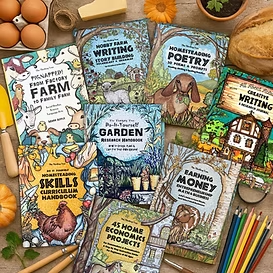
Back to Basics Homesteading & Farm Bundle– Nature study. Essential homestead and farm skills. Handicrafts. Economics. Writing. And more! Some of the journals are available individually as PDFs and all are available individually as Paperbacks as well.

Nature Study & Outdoor Science A Charlotte Mason-inspired nature study journal used by Wild + Free families around the world!

Core Journals– Seasonal core journals to cover all the major school subjects- and nature study in one place. Each has a fun seasonal and nature-inspired theme. Summer. Spring Girls. Spring Boys. Winter Girls. Winter Boys. Autumn.

Wilderness Adventure Handbook Essential wilderness survival skills presented in a fun way. Teaches outdoor safety, survival, wildlife skills, and more. A fun group study.
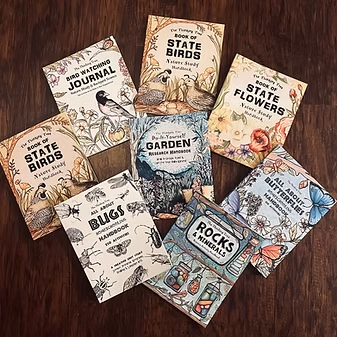
The Backyard Science Bundle-Our most popular nature study journals all in one bundle. The journals are available individually as PDFs and Paperbacks as well.


Read More-

Budget-Friendly Tips from Real Fun-Schooling Moms!
The Princess of Montgomery Woods
Fun-Schooling Lifestyle, Practical Tips & Reality 

What to do if there isn’t a journal about what your child wants to study

This comes up frequently in our Facebook group. Someone’s child wants to study X subject, but we do not have a themed journal based on that subject.

Here are a few thoughts and options-

  • Students do not need a themed journal. When we first started making journals, they were all generic. All they need is the books, podcasts, internet, documentaries, etc. and a journal to document their learning.
  • Core journals are specifically designed for students to study any subject in the world. Yes, some are themed. Most are not.
    AND just because a student has a themed core journal, it doesn’t mean they have to only study the topic of that journal- or even study anything based on that journal at all! We have had a student use a horse core journal to study technology. Another student used the Songwriters journal to study theater.
    Browse core journals here
  • Many single-subject journals can be adapted to study a wide range of topics.
    For example, use white out tape to cover the headlines in Past Times History and your student can write news articles on any topic they want- or use it for written narration and/or general documentation of their learning.
    Alternatively, use the blank side of the Brain Games page for notes – some students find this approach particularly effective, alternating brain breaks with a Brain Games page and writing their school notes on the other side. We’ve ever had students create their own journal pages on these blank pages!
  • Our Reading Time journal and Master Class are set up to be used for studying any topic without as many subjects as a Core Journal
  • Use one of our blank journals- we have several that are completely blank inside. I will post their cover images and links below. Your student can decorate the cover to make it be about their topic of study!

What other outside-the-box ideas have you found for helping your student follow their passions and study their interests?

Blank inside journals

We have several more of the “Make Your Own Book of…” here. They are all the same inside, other than the Math journal.

Helping your creative student THRIVE

Does your child seem to learn like no other? Are they bursting with ideas? Do they need to build, paint, draw, photograph, and create? Is it hard for them to sit still- they always need to MAKE something?

If your child is always sketching, storytelling, or turning random objects into masterpieces, you might just have a Creator Learner. Let’s dive into how to nurture their gifts and make learning a joyful adventure!

Creator kids are the dreamers and doers. They don’t just want to learn facts—they want to make something with them. These kids show their true colors when given freedom to create. They’re the ones building elaborate LEGO worlds, not because they’re told to, but because their minds are buzzing with stories and possibilities. They learn best when they can express themselves, whether through art, music, writing, or even math turned into a creative puzzle.

What Else Can I Do?- Helping your creative student THRIVE

Homeschooling a creative student is about giving them tools to bring their ideas to life. Here are some ways to spark their imagination:

  • Let Them Tell Stories: Creator Learners love weaving narratives. The Secret World of Talking Animals lets your students dive into imaginative worlds and craft their perfect stories. While Creative Comic Book Spelling journal turns spelling practice into comic-strip adventures, letting kids craft stories while mastering words. Mix in a bit of history study with the Past Times Paper. Put students in the role of the reporter of key events in American history.
  • Make Math Imaginative– Math can be painful for creative students because it feels too rigid. Try Create Your Own Book of Complicated Math Concepts—it’s a playful way for students to approach math. They can design their own problems & projects and write stories around numbers. It helps make math a creative quest. This is also a good option to use alongside your chosen math curriculum to solve equations and document learning.
  • Music as a Muse: If your child writes their own tunes or dreams of performing, the Singer & Songwriter and its companion Workbook are perfect. These guide them to write songs, explore emotions, and even design album covers, blending music with self-expression.
  • Building Art Skills: For kids who want to develop their drawing skills, try Teach Yourself to Draw. These books encourage them to explore techniques and create portfolios of their own designs. The Artist Core Journal lets your Creator Learner study all the basic school subjects with a focus on art. They’ll complete art challenges, work on their skills, and learn about art & art styles worldwide.
  • Give them the World as Inspiration: My Wide World Fashion School gives your student a chance to design clothing inspired by cultures worldwide—they’ll even sneak in some social studies along the way! Tropical Birds Research Journal incorporates nature study, science, and art. The color photos capture the imagination of artists and there are plenty of drawing and coloring opportunities included too.
  • Capture the World: Creator Learners often see beauty everywhere. The Camera Quest journal turns photography into a learning adventure, prompting them to snap photos and write about what they see. It’s like a scrapbook of their unique perspective. This is also popular with students who have desires for a career in filming.
  • Destress and Relax: Even Creator Learners need a mental workout. Morning Light Brain Games offers puzzles and activities that feel like play but sharpen their thinking, giving them new ideas to fuel their next project.

Creator Learners thrive when the focus is shifted away from grades or perfection to joy, creativity, and discovery. Homeschooling a Creator Learner means trusting their process. They might not follow a straight line, but they’re building something incredible. When they’re deep in a project, they’re learning to think, solve problems, and express who they are. That’s the heart of Fun-Schooling—celebrating their gifts, not fixing their “flaws.”

So, if your child’s desk is a mess of sketches, half-built models, or story fragments, don’t worry. You’re not raising a kid who fails—you’re nurturing a Creator Learner who’s growing every day. Grab one of these journals, step back, and watch them soar.

If you’re homeschooling creative kids, we’ve created this bundle just for them. It’s also a popular Mom School bundle! It contains our most popular journals for Creator Learners and a suggested lesson plan. It and many of the journals mentioned above are on SALE for our April 2025 Creator Month.

PEEK Inside THIS BUNDLE – 

Hop over to Facebook and Instagram for a chance to peek inside the bundle. 

Stay tuned monthly as we announce a new secret theme with sales, giveaways, bundles, tips, and more.

Let us know what other questions and resources would be helpful for you to homeschool your Creator kid.


Read more about Fun-Schooling Creator Learners

One Book for Every 300 Children? Let’s Fix This Together.

Did you know that in many low-income neighborhoods, there is only one age-appropriate book for every 300 children?

I didn’t believe it, and then I did the research. It’s true.

When I first saw that statistic, my heart sank. Compare that to middle-income communities, where the ratio is 13 books per child. The gap is heartbreaking—and it’s not because parents don’t care. It’s because they’re exhausted, overwhelmed, and often just trying to make sure their kids are fed and safe. And they assume the school will provide needed books. Owning books, just for fun? A luxury when basic survival is the priority.

But here’s the part that really gets me: These children almost all go to public schools—schools that often spend over $15,000 per student, per year. And yet… many of these children still don’t learn to read well. Why? Because they don’t have anything to read at home that brings joy, sparks curiosity, or meets them where they are.

What about libraries? A lot of kids don’t use the library, their parents are afraid of the fees. It’s also hard to walk places these days.

As a homeschooling mom who has built a life around Fun-Schooling, I believe in the power of reading for pleasure. Kids learn best when they’re exploring their interests and reading things that light up their imaginations. That’s why we surround our children with books—not just textbooks, but beautiful, quirky, creative, silly, engaging books that they want to read.

What Can We Do?

You and I might not be able to change national education policy overnight, but we can absolutely flood book deserts with life-giving stories—one child at a time.

Here are some simple, powerful things homeschool families like ours can do:

Click here to keep reading! 📚

Empowering Parents: A New Vision for Education

I remember the day I failed third grade. I couldn’t read. I was dyslexic, and no one seemed to know what to do with me. I was the kid falling through the cracks—misunderstood, frustrated, and embarrassed. Public school wasn’t designed for kids like me.
In second grade, when I was clearly struggling, my parents tried sending me to a small private school, hoping I’d finally get the help I needed. But after just one semester, I had to return to public school. My parents simply couldn’t afford the tuition. There were five of us kids, and they were raising us below the poverty level, doing their best to make ends meet during the tough years of the 1980s recession.
Back then, school choice didn’t exist for families like mine. If you couldn’t pay for private education, you were stuck—no matter how broken the system was for your child.
It wasn’t until I began homeschooling myself—leaning on our tiny local library as my greatest resource—that I discovered I could learn in a way that made sense to me. I fell in love with books on my own terms, and eventually built a life around helping other families do the same.
That’s why when I heard that the Federal Department of Education is being dismantled, I didn’t feel afraid. I felt hope.

Federal Control Has Failed Too Many of Us
For decades, the Department of Education has been a bloated, bureaucratic system that pours billions into programs that don’t serve the individual needs of kids. The budget has ballooned to over $200 billion, yet student outcomes are declining, teachers are exhausted, and children like I once was are still getting left behind.
The truth is, it’s the parents, not the system, who know their kids best. When we remove top-down mandates and give families and communities the freedom to shape education, that’s when real learning happens.

What Happens When States Take the Lead?
Some states—like Indiana and Florida—are already showing what’s possible when you trust parents and empower communities.
To be clear, their public schools still face many of the same struggles as other states—overcrowded classrooms, testing pressure, and teacher shortages. But here’s the difference: more kids are now getting access to customized education, because alternatives are allowed to thrive, and parents are finally being heard.
In these states:
• Homeschooling, hybrid schools, and microschools are supported—not burdened with red tape.
• Education funding can follow the child, giving even low-income families real choices.
• Public schools are being influenced by parents and communities who are showing up and speaking out.
This is huge. It means that a child like me—dyslexic, struggling, and poor—would have had options. I wouldn’t have had to fall through the cracks.

What About the Kids Who Still Depend on the System?
People often ask, “But what about the underprivileged kids? What about the ones with parents who aren’t involved? They rely on public school—what happens to them?”
It’s a hard question. And the truth is, those parents are often products of the same system that failed them. Many of them still trust it—or at least feel they have no other choice—because they never saw another way.
But hope spreads when local communities are given the authority to create better options. The kids who succeed, regardless of income, are almost always the ones who have caring parents and strong local support systems around them. That’s why the solution isn’t more federal control—it’s more community involvement.
Let’s give families the power to create something better right where they are.


I Still Believe in Public Education—But It Needs Parents
I don’t believe public schools are the enemy. In fact, I believe they can become centers of creativity, curiosity, and growth again—but only if parents and community members are willing to show up and be a voice.
We can’t fix it from Washington. But we can fix it from the inside out—right here at home.
When education decisions are made locally, they reflect local values, local needs, and local solutions. That’s how real change happens.

A New Vision for Learning
Now that education is returning to the states, we have a once-in-a-generation opportunity to reimagine education in a way that works for real children—not for test scores or federal checklists.
• Imagine schools with gardens and greenhouses, where children learn by growing things and getting their hands in the soil.
• Imagine classrooms where the library is the center of learning, and children can follow their curiosity instead of filling in bubbles.
• Imagine public schools adopting Fun-Schooling time every day—time set aside for child-led learning, exploration, and creativity.
This is my dream: that every child, whether homeschooled or in a traditional classroom, would be nurtured, seen, and inspired. That’s why I created Fun-Schooling—not just as a curriculum, but as a movement to help rebuild education through joy, freedom, and flexibility.

This Is Our Moment to Speak Up
The end of the Department of Education doesn’t mean chaos—it means opportunity. It means local voices matter more than ever.
So here’s what I want to say to every mom and dad reading this:
• You don’t have to be perfect to be powerful.
• Your voice matters in shaping education.
• You don’t need a degree to advocate for your child’s needs.
Show up. Ask questions. Join the conversation. Be the person who gently challenges the system or starts something new. Whether you homeschool, support your local school, or do something in between—your involvement is the key to change.
I was once a forgotten little girl in a classroom that didn’t see me. Now, by God’s grace, I’ve raised 15 children and helped build a global community of families who are choosing a different path—one full of life, creativity, and real learning.
Let’s work together to create an education system that truly serves our children—all of them.
The future is local. The future is family. And it’s going to be beautiful.

How to Transform Your Homeschool: Perfectionism to Joy

Homeschool moms! Let’s throw our stress overboard! Let’s release the things that cause stress! Let’s set ourselves (and our kids) free from unreasonable and irrational expectations. Somehow we imagined that these unrealistic goals were the right way.
Untangle yourself and your kids from the things that choke out the joy in learning!
Here’s how:
One of the greatest gifts we can give our children is the ability to take their thoughts captive and release burdens that were never meant to be theirs to carry. As homeschooling parents, we often focus on academic achievement, but if we aren’t careful, we can unintentionally plant seeds of anxiety, perfectionism, and self-doubt in our children’s hearts.
God never intended for us to live weighed down by fear or the need to perform for approval. Matthew 11:28-30 reminds us to come to Jesus for rest, and 2 Corinthians 10:5 tells us to take every thought captive in obedience to Christ. These truths are not just for us as parents—they are essential for our children as they grow into the people God created them to be.
So how do we weave these lessons into our homeschool days?

The Hidden Burden of Traditional Schooling
In many educational settings, children are trained to work for grades, external approval, and the fear of making mistakes. Every assignment is graded, every test has red marks, and progress is often measured by how few errors they make rather than how much they have learned.

When children are constantly evaluated this way, they internalize a dangerous belief: “I am only as good as my ability to get things right.”

This burden is heavy, and I’ve seen how it plays out in adulthood. It creates individuals who are afraid to take risks, explore new ideas, or step into their God-given creativity. Instead of growing into confident problem-solvers, they become people-pleasers, perfectionists, or those who avoid challenges altogether because they fear failure.
When I was young, I struggled with traditional academics. I saw myself as someone who wasn’t smart enough, always focusing on my weaknesses rather than my gifts. I even failed third grade!!!
But when I embraced learning on my own terms (at age 13) following my curiosity, using creativity, and celebrating progress instead of perfection—I discovered a love for learning that has lasted a lifetime. This is the heart of Fun-Schooling.

How Fun-Schooling Releases Burdens
Fun-Schooling is not about performance—it’s about passion, mastery, and lifelong learning. Instead of burdening our children with the fear of failure, we give them the tools to learn with confidence and joy.
In our home and in thousands of Fun-Schooling families, kids don’t study to earn grades or please a teacher. They study to pursue knowledge, build skills, and prepare for the future God has for them.

Traditional school teaches kids to focus on their mistakes.
Fun-Schooling teaches kids to focus on their gifts.

When kids are given the freedom to research, explore, and follow their interests, they become fearless learners. They know that making mistakes isn’t failure—it’s part of the process. Instead of becoming burdened by anxiety, they develop the mental strength, confidence, and peace that are uncommon in traditionally schooled children.

Teaching Kids to Take Thoughts Captive
So how do we practically help our children apply 2 Corinthians 10:5—taking every thought captive—and Matthew 11:28-30—laying down heavy burdens?
Here are a few ways to include character teaching in your homeschool day…

Click here to keep reading!

Fun-Schooling & “The Let Them Theory”: A Perfect Match

As a mother of 15 and the creator of Fun-Schooling, I’ve spent decades helping families embrace a natural, joy-filled approach to learning. Recently, as I’ve been reading The Let Them Theory by Mel Robbins and listening to her podcast, I realized just how deeply her philosophy aligns with what I’ve been teaching through Fun-Schooling for years.

For me it started on the day I woke up, a homeschool mom of eight who was worn out micromanaging their education and depressed because there was no joy. So I said, “Today I will just say YES to whatever they want to do.” I had created a beautiful environment for learning, but curriculum was boring, limiting and too much work for me. I was drained and wanted to enjoy being a mom while homeschooling. I told my kids, “We are going to Fun-School today”. It was amazing. The learning that happened amazed me, and the joy set us all free.

Mel’s Let Them theory is about releasing control, allowing people to make their own choices, and letting go of the urge to micromanage. Fun-Schooling is based on the same principle—letting children study what they love, explore their passions, and skip the boring, outdated schoolwork that kills curiosity. Instead of forcing learning through rigid, one-size-fits-all curriculums, we let kids take the lead, trusting their natural desire to grow, explore, and create.

Here are ten ways Fun-Schooling and The Let Them Theory are a perfect match:

Let Them Learn What Excites Them

Mel Robbins encourages us to let people pursue their own interests, even if we don’t understand them. Fun-Schooling follows this same logic: if a child is obsessed with horses, let them dive deep into everything horse-related—biology, history, art, business, and storytelling—all through their passion.

Let Them Skip the Boring Stuff

Traditional education forces kids to memorize facts they’ll never use, leading to burnout and frustration. But what if we let them skip what doesn’t spark their curiosity? In Fun-Schooling, we trust that when a child is deeply engaged, they’ll develop the skills they need naturally.

Let Them Make Mistakes

Mel emphasizes that people learn best through their own experiences. Fun-Schooling embraces this truth—kids don’t need to get everything “right” the first time. They need freedom to experiment, fail, and try again without fear of judgment.

Let Them Go at Their Own Pace

Not every child learns on the same timeline, just like adults don’t all hit milestones at the same time. Fun-Schooling allows kids to develop skills when they’re ready, not when a curriculum says they should.

Let Them Create Instead of Conform

Mel Robbins challenges us to step away from people-pleasing and embrace individuality. Fun-Schooling does the same by giving kids the space to create, imagine, and build rather than just regurgitate facts.

Let Them Follow Their Curiosity

We trust that adults will figure things out when they’re interested in something—why don’t we extend that same trust to children? Fun-Schooling encourages kids to chase their curiosity, knowing that a self-motivated learner will always go further than a forced one.

Continue reading by clicking here.

Be a More Joyful Mom by Following Sarah’s Life Tips!

These tips are from a post back in 2016. Some truths are timeless. Scripture truth will always “age well”. These simple truths will help to keep you peaceful, joyful, and grounded as a homeschool mom.

1. Don’t make decisions based on your fears.

2. Don’t gossip. “A whisperer separates the best of friends.” People who gossip to you, will gossip about you.

3. Take advice from the people you want to be like. There will be people who try to control you, but do you want to end up like them?

4. Don’t take advice from people who are driven by their fears. Take advice from those who live by faith and trust in God’s word.

5. Don’t be afraid to make mistakes. When they happen learn from them.

6. Overlook most of the stuff other people throw your way.

7. When in doubt, be gracious. Wisdom is knowing what to overlook.

8. Take a minute to encourage a child, no matter how busy you are.

9. Before you complain, remember the cross.

10. Enjoy today and love the people on your path. They are there for a reason.

11. If you have a dream, give it feet. What is the worst that could happen? God gave you that dream, don’t waste it.

12. Greed is ugly. Pride is ugly. Selfishness is ugly. Grace is amazing!

We’re Following the Leader: Nurturing a Love of Learning Through Structure and Guidance

Are you homeschooling a child who thrives on directions and instructions? Does your child prefer to work with clear boundaries and structure? Does your child follow instructions in kits and recipes exactly? Is your child eager to please and loves to gain approval from adults and others they respect?

If you answered yes to any of these questions, you are raising what we call a Follower Learner.

Follower kids often thrive in a more traditional school-like setting. This doesn’t mean they can’t be home-educated, though. Today, we’ll offer a few tips for helping your Follower Learner develop a lifelong love of learning.

Homeschooling Follower Learners- Nurturing a Love of Learning Through Structure and Guidance

Unlike Explorers, Follower learners are not necessarily driven by a need to “discover” or question the material. These learners want to do things correctly and succeed by the given standards. 

Usually, these students won’t ask, “Why do I need to know this?” They’ll be motivated by the learning process itself, completing assignments accurately, and getting approval from others. However, outside-the-box thinking may be a bit more difficult for these students. Sometimes, this can be hard for parents who want a more relaxed homeschool. These students often require more effort from parents to provide a setting with clear expectations, schedules, and structure.

Building Skills and Confidence in Follower Learners

One of the best ways to support Follower Learners is to provide materials that cater to their need for clear instructions and guidance. Some of our more open-ended journals will frustrate Follower Learners. Parents may need to provide guidance and direction for these kids. For example, a sticky note with exactly what pages should be read from which book, how long an answer is required, and any other guidelines. We also offer several more structured journals, some of which I’ll mention below. As your student completes these activities, they will build confidence! 

Our journals offer predictable, engaging content and activities that help Follower Learners develop attention to detail, focus, and comprehension skills. Through these resources, your child can develop a love for learning.

Creating a Structured Learning Environment

Your Follower Learner likely appreciates a schedule. Starting the day with something like “circle time” and a visual schedule can be helpful. You do not have to be rigid in saying x activity at x time. Providing them with an expectation for what will occur in what order helps. Many families with Follower kids include pictures of the journals a student will be working in for the day. Have a quick wrap-up at the end of the day. This will give your Follower a chance to see all they accomplished and receive feedback- which they thrive on- from you or another adult! 

Journals like Transportation History and Adventures Around the World will appeal to their love of lists, charts, and historical facts. Each section of these journals is structured the same way, giving your Follower learner a clear expectation and predictability for what’s to come. Meanwhile, topics like Rocks & Minerals, All About Rainforests, and American History Timeline will appeal to their interest in organized, factual knowledge and clear timeframes. These provide a lot of structure and guidance—American History Timeline is one of our most structured journals.

Activities and Projects for Follower Learners

It is essential to have projects and activities that allow Follower Learners to follow instructions. Piano Lessons for Kids gives students a chance to learn to play without needing to hire outside help! They include lots of structure and detailed instructions for your students to learn to play the Piano confidently. The lessons will also appeal to their desire to please others by providing beautiful music for your home. 

Candlelight Brain Games is the most open-ended suggestion I will make today. Though it still appeals to Follower Learners. The goal of our Brain Games is to complete the missing parts of the pictures. Many Follower kids love it when a parent, older sibling, or another adult works on these with them. These allow students to embrace imperfection and creativity. If they become completely stuck, you can complete part of the page to give them an idea of what to do- or let them watch you finish it in your own copy.You can also encourage their love of lists and organization with projects like the Garden Research Handbook, which outlines the steps of planning and cultivating a garden. Through hands-on activities, they can see their plans come to life.

Fostering Independence While Providing Guidance

These learners also LOVE to follow any rules they possibly can. The Top 30 Grammar Mistakes is always a favorite for Follower Learners. It clearly outlines exactly what you should and should not do in Grammar. It is a journal students will sometimes complete once in late Elementary School/early Middle School and then again in High School. No matter your student’s future career or calling, knowledge of proper grammar will be needed. This is an excellent way to provide it in a way they can independently learn.

Our goal is always to help foster independence in our children. Rocks & Minerals and All About Rainforests also include fun hands-on projects for your students to complete. These give them another chance to follow instructions and learn to complete projects independently. Of course, you’ll be there to offer any needed guidance. For the most part, students should be able to complete these projects alone. 

You can also encourage students to create “step-by-step” guides for things they enjoy. By increasing their autonomy, you will help them learn to make decisions while still providing the support and structure they need to succeed. 

Involve Them and Have Fun!

Homeschooling Follower Learners is an exciting journey where structure, guidance, and encouragement are key. Ask for their feedback. See if they need/want more or less guidance, instruction, and lessons. Gradually ease up and see what they do independently after a while. About six weeks is a reasonable length of time to try something out. Then ask for their feedback and see what else would be helpful for them. As always, reach out if we can help at all.  With the right resources, like the We’re Following the Leader bundle and carefully selected books and activities, you can help these learners thrive, develop new skills, and take pride in their accomplishments. By fostering a structured yet nurturing environment, you’ll empower your Follower Learner to reach their full potential and enjoy the learning process every step of the way. 

If you’re homeschooling social kids, we’ve created this bundle just for them. It contains our most popular journals for Friend Learners and a suggested lesson plan. It and many of the journals mentioned above are on SALE for our March 2025 Follower Month.

PEEK Inside THIS BUNDLE – 

Hop over to Facebook and Instagram for a chance to peek inside the bundle. 

Stay tuned monthly as we announce a new secret theme with sales, giveaways, bundles, tips, and more.

Let us know what other questions and resources would be helpful for you to homeschool your Follower kid.

The Story of Fun-Schooling: Happily Ever After

I never set out to start a movement—I was just a mom trying to help my kids love learning again. 💡

One of my daughters struggled with dyslexia. Traditional workbooks drained her confidence and made her hate reading. So, I created hand-drawn journals—full of coloring pages, storytelling, and creative prompts—and suddenly, she thrived! 🌿✨

Other moms started asking for copies, and before I knew it, Fun-Schooling was born! Families around the world—especially those with dyslexia, ADHD, and creative learners—discovered a better way to homeschool: interest-led, joyful, and stress-free.

Now, with over 300 books and a global community of families, Fun-Schooling is helping kids fall in love with learning again. ❤️

If homeschooling feels boring, stressful, or rigid—maybe it’s time to Fun-School! 🎨📚

💬 Have you tried Fun-Schooling? Share in the comments! Ready to get started? Visit funschooling.com