How Your Child Thinks: The Inventors (Part 3)

visual thinkers inventors creators

The visual thinkers of the world were created to be the designers, inventors, the artists, the musicians, the sailors and explorers. We say they have a problem with obedience and respect or we call it Dyslexia, Asperger’s Syndrome or ADHD. We try to tame them. Honestly, we have failed them . If a child is failing in his classroom, it is the classroom that failed the child. The child is not the one with a problem just because he learns differently.

The child must be set free to be the inventor, the artist, the dancer. So who will teach the inventor? Who will train the artist? The child must become his own teacher, and his parents and teachers must become his students, to learn from him, to understand him, to realize that he has within him the power to become great. We need to discover how to help him become who he was meant to be. We must accept that it may never happen in a desk, in a classroom and behind a pile of textbooks, even if you give the child medication and take away his crayons. Do you want to be the one to take away Albert’s compass, Benjamin’s kite, or Leonardo’s paintbrush or little Thomas Edison’s mirrors?

What is the solution for the child who fails in the classroom? Set him free from the classroom. Ask the child what he wants to learn about. Ask the child what he wants to do. Take the child to the book store, take the child to the art store, take the child to the beach, the forest, the ruins of a castle. Give him pets and let him catch lizards. Read to him until he learns to read to himself. Search for learning materials that captivate the visual mind–things like compasses, clay, mirrors, and paintbrushes. Let him sail, play instruments, and dig in the dirt. Let him take things apart and give him colored pencils. Let him watch people at work doing all different things in the world, take him to the kitchen, take him to an art studio, take him into factories and show him how to use sewing machines, instruments, scroll-saws, and tools. Let her dance. (to continue reading click here)

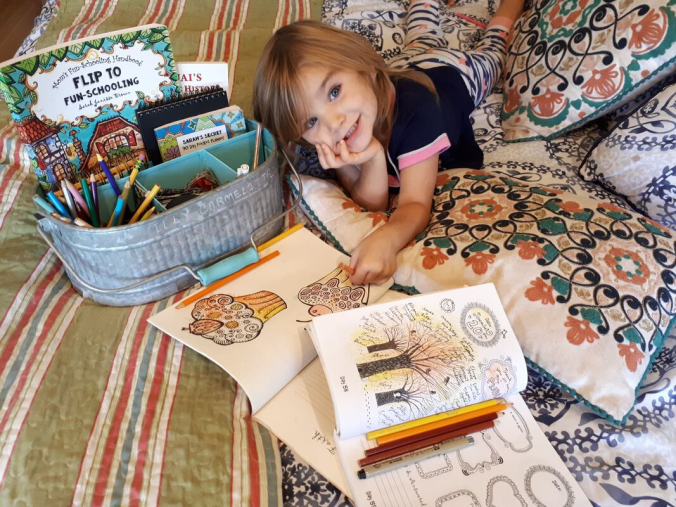
A Fun-Filled Homeschooling Plan for Busy Parents and Active Kids

My Real-Life, Home-Learning Plan that is simple for parents and delightful to kids! Created by me, a mom who is currently Homeschooling 10 of her 15 Kids!

1. Logic Games2. Read Favorite Books
3. YouTube Tutorials
4. Nature Time
5. Online Math Games or Serious Stuff
6. Kitchen Time
7. Spelling Games
8. Complete 5 Workbook Pages or 5 Fun-Schooling Journal Pages
9. Play Outside
10 Art & Drawing
11. Just Dance
12. Chores
13. Online Games (a reward for chores and school)
14. Family Time and Board Games
15. Movie Time
16. Music Practice
17. Games for Dyslexia: DyslexiaGames.com
18. Fun Homeschooling Curriculum: FunSchooling.com
You can do these activities in any order, but Movies and Online Games should be close to last.

Dyslexia

(This series of blog posts is excerpted from Sarah’s book, Windows to Our World: Sarah’s Journal – Growing Up, Crossing Oceans, Finding Love & Giving Life to 10 Children)

Anna is the author of “Heroes & Villains of History” and “Writer’s Fun-Schooling Journal”

Isaac started reading at age three. Back then, I thought homeschooling was going to be easy. Anna, our second child, was born dancing, drawing, and dreaming, but at age nine she was still reversing letters and forgetting how to sound out three-letter words. She continued to struggle with pencil and paper, and I didn’t know why. I had started both children with the same reading program, but Anna wasn’t learning to read.

I tried several reading programs over the years, but nothing helped. Nothing interested her. Reading was exhausting and confusing. I really began to feel like there was something wrong with her, and because we were homeschooling, I blamed myself. I was afraid to talk to anyone about Anna’s problem with reading. I never suspected dyslexia. I just thought I was a bad teacher until Estera, our third, taught herself to read and write at age five. She would always play school with the workbooks that Anna couldn’t use. By then, we had dozens of them.

One fall day a couple of years earlier, Anna and I were sitting under the big tree in the backyard working on reading lesson number one for the 30th time. I was still trying to help her see the difference between b and d. We were making a new set of colorful flash cards but seeing no progress.

She looked at me with tears in her eyes. “Mom, there is NO difference! I will never read!” she said. “Can’t I just be an artist and a mommy when I grow up?” I remembered having the same dream when I was a little girl and the same struggles. I had blamed the school system for my problems with reading, but Anna was being homeschooled, how could the same thing be happening to her?

I looked up into the sky and asked God to show me how to help my child. The first thing I realized was that I didn’t have what it takes to help her and needed to seek out a professional. I had to get over my own fear and pride and ask for help. The first reading tutor we hired was mystified by Anna’s problem too, but we eventually found a specialist who understood Anna. The teacher evaluated Anna and revealed that she had dyslexia. (click here to continue reading)

Sarah’s Mom Tips: Literacy Questions

Question: “How do you handle a very active 7-year-old who can’t sit still and always complains about writing. Could it be that he’s just not ready? How can I encourage my 10-year-old to do independent work, even though he can’t read? Is that even possible?”

A lot of times the younger children who can’t sit still and write should just play. Just let them play. They’re never going to get those carefree days of childhood back. If you have a child who is obviously not ready for writing, just give them time. In a year or two they’ll be ready. I’d definitely say for the active 7-year-old you are going to want to just give them tools to learn about their interests. Give them Fun-Schooling Level A books that don’t have a lot of writing in them, but they have a lot of activities that can be done by kids who are not strong readers yet. Same thing for the 10-year-old who isn’t reading much yet. It’s okay for these kids to use the Level A books because they are for kids who are still struggling with reading. There is a really wide age range that can use those. Don’t be too stressed. If you are worried about their ability, definitely do Dyslexia Games because it really helps them to develop the skills they need for literacy without the stress and too much effort on your part.

Question: How did you teach your kids with Dyslexia how to read?

I did not teach them to read. I tried and tried and just could not teach them to read. I tried all the books, all the methods, all the videos and all the tutoring. It had to get to the point where they wanted to read, and they taught themselves.

What we did was create the Dyslexia Games, and they are awesome for prepping their brains for reading. By the time my kids got through Dyslexia Games Series A and Series B, they were reading. The same thing has happened for thousands of other kids as well. They understand phonics, they have gotten down a lot of sight words and they move on to the Fun-Schooling spelling journals.

For my kids who don’t have Dyslexia, I used Teach Your Child to Read in 100 Easy Lessons, and Reading Eggs and Time4Learning, and after four or five months with those things, they’d started reading. With the Dyslexic kids, you can try all those methods for four years, and as long as you’re pushing phonics, these kids are going to struggle. You have to deal with what’s going on in the brain, and that’s why Dyslexia Games works well.

Sarah’s Mom Tips: Strategies for Different Learning Styles

Recently a mom asked this question:

How should I handle a child who doesn’t put forth much effort on the Fun-Schooling pages?

The truth is, he was just hacking his homeschooling and doing the minimum, which is what kids do when they want to move on to doing something they feel is more important. The problem is that kids all have a different learning style. We make Fun-Schooling journals for all the different styles. Let’s start off by talking about these, and what I call the Five Learning Languages.

There are some kids who are Creators. The kids who are Creators learn everything for one purpose: to create something. All their education has to revolve around creativity. That’s what they are motivated by. These kids will not do normal workbooks. They need things that are open-ended, that revolve around their passions and interests.

Then you have the kids who are Detectives, who get really deep into the one thing they are passionate about. They love research and are not interested in anything that you want to teach them. They are only interested in what they want to learn. They are very difficult to give a standard education to because they aren’t going to remember anything or make any effort to retain anything that doesn’t revolve around their interests.

Then we have the kids who are Explorers. These kids will not sit still. They can’t. They want to be going from place to place. They can give maybe 5-15 minutes of focused attention to some sort of lesson, or activity and then they need to switch. They won’t sit at a desk, doing workbooks, textbooks, or even online school that makes them sit for very long. I developed a lot of materials for this kind of kid. We call them the “active kids”.

Then, the next kind of learner is the Friend Learner. These are kids who are motivated to learn through social experiences. They do not want to sit by themselves and do anything. They want to be with somebody collaborating, bonding, talking, or doing a project or reading with someone. If you ask this kind of kid to do something alone, they are going to get bored and distracted and wander off to find somebody to play with. Sometimes pets help.

Finally, we have the classic students, the little scholars, and we call them the Followers because these kids just want to please the teacher, the boss, the authority, the leader, the parent. They will do everything you ask them to do really well, step by step. They don’t put their heart into it for the sake of learning, but more for the sake of making somebody proud. They really like grades and scores and tests and multiple choice and ways to just prove that they are good at something and worthy. They are really good at “in the box” type of schooling, but a lot of times they don’t tap into their own creativity and curiosity. (click Page 2 to continue reading)

Work or Play? Why not BOTH?

Whenever my kids are playing hard and having the BIGGEST fun doing whatever kids do, when no one is telling them what to do I always ask them, “What are you working on?”  I use the word “WORKING”.  I call their activity a PROJECT.   They never say “Nothing, I’m just playing.”  No, they go into a detailed description of something amazing, that starts with: “I’m trying to build a… I’m figuring out how to… I am making a…  I’m taking this thing apart… I’m putting together a new!”

When they are playing they are often doing work that is very meaningful and important in their eyes.  I have a daughter who was always very, very busy, I was always trying to pull her away from her “play” as if it were a waste of time, because I didn’t yet see the value of play. After all, she was 9 and should be doing things that look like school. She knew how to read and write, and she was always in her own world.

One day it was raining outside and she was looking out the window.  She had been there for a long time. She was supposed to be in the school room with her science book.  I was about to tell her to stop sitting around and get back to work.  Then I noticed she had a notebook with all these strange little marks, pictures, checks and numbers.  So I asked, “What are you doing?”

“Oh, I was just charting the storm, timing the lighting and the thunder and measuring sound and distance.  I’ve been charting the weather for about a month.”

I started unschooling that child on that day, and at that point I began to ask my kids what they are working on when they seem to be playing or busy.  They always amaze me with their answers.I couldn’t find anything in the 3rd grade school books that could have been more educational and meaningful than the research our daughter had been doing on her own. I just began to ask more often what she was working on and then I began doing everything I could to support those interests. She is the one who recently gave me the ideas for the 10- and 12-Subject Portfolios! I think it is funny that my unschooled child would be the one to want to design such a structured subject-by-subject learning plan for herself!

She has learned so much about so many subjects over the years and now she wants to put all her knowledge together in a Portfolio that is well organized. 

All of my children need differing amounts of structure, motivation, instruction, teaching, guidance, assignments, evaluation, and follow-up with their learning.  They are all unique.  My dyslexics need a lot of my help and investment when it comes to learning to read, write, and spell.  Dyslexia Games makes it easy, now that it exists. (continue reading by clicking Page 2 below)

Sarah’s Mom Tips: Making Writing Fun!

Don’t worry about having children write before they are ready. The Thinking Tree spelling books are really good for children who are not ready for writing. They color the words and write the specific words and they also do a lot of drawing. As the books advance, some of them give the child an opportunity to do creative writing. If your child is not ready for the writing the BEST BEST BEST thing to do is ask the child what YOU should write for him. When the child sees you writing it stirs something up in their minds and they begin to develop the ability and desire to write.

If I am writing a story for my child (think 3 sentences) and I arrive at a word that I know that they know, I would say “How do you spell ‘cat’?” They giggle and are happy to tell me how to spell. Next I will stop writing when I get to a word that they can write, and just say “Your turn!” and hand them the pencil so they can add a simple word. One nice thing about this method is that the child will try to mimic your letter size and style. Another fun way to get a child writing is to have the child DRAW a small picture of the nouns in the sentence.

If you do get to a place in any of the Thinking Tree Spelling books or Dyslexia Games where the exercise is too advanced (for example, if the “spaghetti lady” causes dread), I would be an example and say, “You don’t want to do the spaghetti lady? That’s GREAT because I WANTED to do that one! Can I PLEASE do your spaghetti lady?”

This advice may go against everything you have learned from being in school yourself. If your child complains that something is too hard or too boring – DARE to do it yourself. Say “Oh really? Can I give it a try? It looks interesting to me!” But if it is super boring, agree with the child, give it a try and have fun. It’s okay to say, “You are right this is SOOOO boring. Let’s have a snack, and turn on some music! Don’t you think that music will make this more fun?”

Now, if the schoolwork is totally irrelevant, and you are unwilling to do that kind of work yourself, maybe you should pitch it.  I know we worry about the money we spent on nice curriculum – so put it on the shelf and tell your children they can use those books to “play school” with their friends or stuffed animals. If you are trying to FLIP to FUN-Schooling and spent all you had on something boring, and it’s not in your budget to buy a homeschooling journal – let me know, I can help you with a PDF version of a journal.

When I was a kid in 1st to 5th grade I HATED spelling tests. I got Ds and Fs on my report card in Spelling. No one knew it was dyslexia. I could not memorize; but when I would take a spelling test I would forever remember the spelling that I came up with on the test – WRONG or RIGHT. I was so emotional while being tested that the negative feelings burned the misspelled word into my brain. I would have 45% correct on the test, and the teachers NEVER worked with me to correct the mistakes. That is why I now create spelling books that work for visual thinkers. I would advise you not to give spelling tests to a dyslexic child. Just look at their creative writing projects. If they write, color, trace and say the letters WITH the correct spelling SEVEN times they will remember the correct spelling, by the time they are 14 years old. Most spelling problems do self-correct by age 14 if the child does a lot of reading. That’s why we have just a few spelling books that cover the words that are foundational to learning to spell – AND are commonly confused or misspelled.

Sarah’s Mom Tips – Prioritizing ALL the Things!

As you plan to Fun-School a child under 10, don’t feel like you need to do everything on your list every day.

Listen to your child and watch for what brings them joy. You will learn what subjects and topics your child is passionate about, and those are the ones you should do every day and spend more time on (if the child wants to spend extra time researching their favorite topics).

Many teachers focus the most on the child’s weakness and problem areas. I do not focus more than 20 minutes a week on the problem areas – if the lesson or activity burns them out. If reading is a struggle, I use Dyslexia Games, but only 15 minutes a day – unless they want to do more. Usually they like Dyslexia Games, so it isn’t a struggle.

If math is a struggle, use games, calculators, and our new book 100 Numbers.

If they seem confused when trying to learn math, stop using a memory approach and teach then the WHY and HOW of numbers. They may need time to mature to be able to grasp new concepts. Children need to understand, not just memorize.

Make a lot of time for play, curiosity and discovery.

Children who are entertained constantly, over scheduled, or are addicted to gaming have a lot of issues. You can avoid MANY problems by making sure your child has time to use their imagination and PLAY without constant electronic stimulation. Kids often opt to be entertained. Boredom is okay and leads to innovation.

Healthy children often can’t sit still for more than 20 minutes at a time. They are wiggly by design, children need to move their bodies while learning.

If there is a topic or book that you want to use that they don’t enjoy, you can let it go OR do the work together OR you do it while the child watches you do it.

Make sure your child watches you write – in print and cursive, that’s what the Mom School books are for.

Feel free to use audio books in place of reading, so the child can learn on a higher level.

Throw out anything that makes your child miserable when trying to learn.  Try the fun and joyful methods.  If there is no fun and joyful way to learn, you may be dealing with a maturity issue.

Kids on sugar may seem crazy and out of control.

Kids who do not sleep enough may seem moody and out of control.

Kids who see adults fighting or are exposed to violence on games and movies may seem depressed and unmotivated to learn.

Kids who text all night are often lazy all day. Is your child sleeping with a phone?

Find your child’s passion, and feed it.

It is good for kids to learn to research. Research is an awesome skill that is learned best when a child studies their passion.

Some of most important things to teach your children involve:

1. Reading

2. Research

3. Relationships

4. Responsibility

5. Resourcefulness

6. Rest & Reflection

Put first things first. Outline your goals for each child and help them grow in the things that really matter.

Ignore anything on this list that you don’t agree with, this is my method, and may not be right for your family.

Fun-Schooling Lifestyle, Practical Tips & Reality (Part 1 of 3)

(Transcribed from a Q & A Facebook Live video with Sarah, dated 2/2/22)

My homeschooling adventure began when I was 14 years old, and really struggling in the public school that I was going to, back in 1991. And we didn’t know anybody else who was homeschooling and hadn’t really heard of anybody else who was homeschooling. My parents actually looked into homeschooling because of some health issues my little sister had.  I wonder how many of you started homeschooling because of sickness going around and you weren’t even planning on it? Let me know in the comments!

So, my sister had health problems that couldn’t be handled well in school, and so my mom brought her home, and I was then going to school all alone. It was boring. There was a lot of bullying. I was kind of small for my age and kind of awkward. I only wanted to do art and hated math. So many things I didn’t like about school.

I saw my sister staying home and getting her work done so fast and then getting to do all the things that kids like to do. She got to be with my mom and dad all day. I’d come home from being at school all day long and have to do all the super boring homework that took me as long to get done as my sister’s entire school day.  So I started asking my parents to please let me homeschool. They said we’d have to wait until we got our tax return because they had spent a lot of money on my sister’s curriculum. My reply to that was, “Who needs a tax return and who needs curriculum? Aren’t there enough books at the library?”

We had a library just a couple blocks away and what I said made sense to my parents, so after Christmas I got a library card and didn’t go back to school. It was the best thing that ever happened to me.  My mom got me 5 or 6 composition journals from the store, and I wrote on the cover of every one of those the subjects I was interested in, and took them to the library with me. I asked the librarian to help me find books on each subject. I had my journals, colored pencils and a giant stack of library books—it looked nothing like a standardized education. 

I actually thought I was kind of a dumb, hopeless kid.  I failed third grade, I often got Cs and Ds in school. I was so proud of my A in art, and that’s what mattered to me.  That first year I got to study what I wanted to study, and that’s the heart of Fun-Schooling. That is what inspired me to create journals specifically for our kids to study their passions.

That first year I studied Ancient Egypt for History and designed my own mummy cases. My parents took me to a couple museums that had displays on Ancient Egypt and I got books on hieroglyphics—I was a super happy kid! But I discovered that I wanted to do much more. I was really interested in the history of fashion and I loved fashion design. So I got a big pile of books on that topic. All of that also qualified for Geography because I was interested in fashion around the world. There was a lot of Social Studies involved in fashion and fashion design as well. I also joined 4H and learned about photography and sewing. I had an interest in genetics. I wanted to learn about what makes us who we are. As part of that I got a bunch of mice from the pet store and started breeding them for my 4H project, and that was my Science. At that point I also fell in love with poetry and I started writing my own poems and copying poetry into my journals, and that was my Language Arts.

The only thing my parents ended up buying curriculum for was some Math stuff, and it was super boring and they didn’t really notice that I didn’t do it that year. My little sister needed a lot of attention, and they’d see me sitting there with my big pile of books and journals.  There was a different way I was going to learn Math. (click Page 2 to continue reading)

Discover Your Child’s Secret Learning Language with Legos!

Your child doesn’t learn like other kids. He has to be on the go. She is always creating something new. He just wants to play… ALL THE TIME. She’s not interested in textbooks, but she likes computers. He is in his own world. She loves field trips and hates sitting still. She can’t stop talking. He daydreams. She doodles. She is perfect. He is perfect. They just have a different way of learning.

You may feel like your child is failing in school, when in reality he or she can’t learn well in the traditional educational environment! Some kids have to learn through creating, exploring, asking questions and by investigating. They can’t just sit still and learn quietly in a desk, in a classroom, or with a teacher! You may not know how to discover your child’s optimal learning environment. You may not understand your child’s learning style, but figuring out how your child learns is easier than you think! Just watch him or her PLAY! By watching your child plays with Legos you can discover a lot about your child’s learning style and learning language!

I’ve found that most kids have a dominant learning language. There are five types of learners. You can understand what your child’s learning language is by the way he or she plays with, cares for, and uses his or her Legos.

The FIVE Learning Languages (or Personalities) include: Followers, Friends, Explorers, Detectives and Creators

You can’t really learn about your child’s learning language by the way they approach school work, because most schoolwork is geared toward one type of learner, the Follower. I have found that Legos give kids freedom to be who they were meant to be, so you should be able to really see their true colors shine when they play with them, sort them, collect them and build with them.

Typical education methods usually push kids into a mold that wants to make them into a Follower. Many kids fight with these learning methods because they can’t understand or enjoy such a style of learning. Once you understand how your child naturally relates to learning, you can give them the right tools, the right education, and the most efficient help.

I will explain each of the learning languages that I have observed in homeschooled children, because I have ten children of my own, and have worked with thousands of homeschoolers who are gifted or have learning challenges over the past 10 years. If your child is in school, or your homeschooling methods have been used to make the child into a Follower, you may need to remember what they were like when they were 3 to 5 years old. It’s not a bad thing to be a Follower, if you are a Follower in your heart. Followers actually enjoy school, but if your child resists normal schoolwork, he might speak one of the other 4 learning languages.

I call it a learning language, because we often only understand our own language, or the one we grew up with. We are all parenting unique children with unique needs, and we need to seek to understand how each child learns best. Once we learn their language we can change the way we teach them and we will be able to see and appreciate their amazing abilities. (Click Page 2 below to continue reading)