Let’s Talk Hard Things

Hi friends! Let’s talk hard things.

I just celebrated my 49th birthday, and looking back, I realize I did so many things right—and now I’m enjoying the rewards of a life lived beautifully, though at times sacrificial and hard—because this is motherhood! I’ve grown my own passions, talents, and hobbies alongside my children and never lost myself—and I never lost sight of my calling, and I never strayed long from the way.

I knew my North Star, I had my eye on a mountain top, I knew I had to choose the right direction, and just keep climbing. I couldn’t always see a trail under my feet, but with compass in hand, and a vision of my destination – the chaos, the darkness and the obstacles could be overcome – by faith and perseverance.

There were hard choices to be made along the way, and my husband and I decided, over and over again, not to be driven by our fears and worries.

Now, as I enter my 50th year, I want to consider how I can help, teach, and light the way for younger women who don’t want to lose the light of life along the journey. Maybe you feel like you have lost sight of that North Star, and havent figured out how to read a compass, and even if you could – you have not decided where you are going because your vision and calling is a blur.

The path looks different for each of us, but there’s one very important thing—its the path.

Where do you want to be at 30? 40? 50? 60? 90?

You need to be on the path that takes you there—and I know you are a pioneer.

I know you are brave. I know you are fighting for your child, your home, your family, your sisters, your marriage, and your calling as a woman. I know you are a visionary because you are here. Only the brave explore the world of Fun-Schooling!!!

So I have a question for you: What do you want to learn from me?

I’ve arrived at 49, and my life is everything—and more—than I could have hoped and dreamed because I stayed on the path, even when I had to blaze it.

But I blazed it, so maybe you don’t have to. Many women and families, mothers and marriages, have gone before us—blazing trails, clearing the way by faith in the face of fear.

I once heard a very wise African man share a bit of wisdom in my living room:

“If you thought you were moving in the right direction—you heard the call, you are moving toward your vision—but the journey is much harder than you ever imagined and there are endless obstacles in your way… it’s not because you’re on the wrong path. It’s because you’re the pioneer, blazing that trail.”

You are a pioneer woman. Not because you have chickens, bake sourdough, or have a garden. You are pioneering a future for yourself and your family through the chaos and disconnection of modern society.

You are overcoming obstacle after obstacle—facing challenges humanity has never experienced before 2025. You are battling a Terminator, taming AI, training the next generation, obliterating GMOs in your home, questioning traditional medicine and conventional education, maybe challenging the values of modern feminism, healing trauma, finding faith, experimenting with scary alternatives, and pulling monstrous weeds from the garden of your child’s heart and mind.

You are armed with wisdom and a questioning mind. You take every thought captive. And at times, you feel like a living sacrifice—poured out for love, hope, and a future you can’t even see.

You are making moves. You are navigating good and evil. You are trying to hold a marriage and family together. And you are looking around and seeing your sisters, your friends, struggling and feeling so alone. And you wonder—Am I enough? Am I doing enough? Why am I so tired?

Do you realize how powerful, wise, wonderful, and full of grace you are?
I didn’t think so.
But you are all that—and more.
You are an overcomer.
And it’s so hard.

Friend, sister—
I’ve walked through fire, floods, loss, pain, death, and chaos. And I’ve built my house, my life, my future on the Rock. I have loved.

And I’ve arrived at 49—empowered, wiser, freer, and touched by grace. I still have a ways to go.
Every step of faith has brought me to this beautiful place, I’m seeing everything from a hilltop.

So how can I help you blaze your trail?
How can I help you find your way?
How can I say, You are not alone?
How can I stand on this Rock, on the hilltop, and call out to all the sisters and say:

“If this is the Rock you want to stand on, the path has already been paved.”

Yes, the path is still hard—but sister, I have rolled many boulders off this trail. Now you need to push through the weeds and mud that relentlessly try to take over the terrain—until enough of us walk this way, packing down the path with our footsteps, working together to raise up the low spots and clear out the brambles.

I’m here to help you.
I’ve created so many tools and resources to support you along the way, and I’ve suffered many struggles pioneering this path.

So where are you on the path?
Where are you going?
Who is guiding you?
What’s your map?
What is your North Star?

How can I empower you, encourage you, and equip you—to take one more step?

Fun-Schooling + Wild & Free = a perfect match!

Years ago, I took the kids on a walk after breakfast. We didn’t have a plan—we just needed fresh air and sunlight on our faces. We sat under a tree and read poems, sketched in our journals, and shared apples from a basket. By the time we got home, it had been hours—and I realized something:

That was our whole school day.
And it was good.

Not good because it ticked off a list of academic boxes. Not good because it was planned or polished or even quiet. It was good because it was true. True to the way children learn best—through wonder, through movement, through meaningful moments that speak to the heart and engage the senses. It reminded me of my own homeschooling years, spending hours outside letting nature be my guide.

That’s the same kind of goodness I see in the Wild + Free community.

Fun-Schooling and Wild + Free were seemingly made for each other. Both are built on the belief education isn’t something that happens to a child—it’s something that flows from the child. It flows from their interests. Education is their environment. It is their questions. Their exploration. Following their own paths.

Wild + Free is about gathering in nature, embracing simplicity, and letting go of the pressure to perform. It’s about letting kids be kids—muddy, curious, barefoot, imaginative. It’s about motherhood that values connection over perfection.

And that’s exactly what Fun-Schooling was created to support.

Fun-Schooling is interest-led and delight-driven. It says yes to creativity and no to comparison. It turns the world into a classroom and the family into a learning ecosystem. When you combine that with the Wild + Free philosophy? You get something even richer. You get shared meals outside. Art inspired by the sunset. Science with a pond. Geography in your beautiful backyard.

You get memories.

You get a childhood worth remembering.

You get the freedom to let your homeschool life reflect your family’s values instead of someone else’s curriculum guide.

I’ve met so many Wild + Free moms over the years, and what I love about them is this: they are present. They are brave. They are willing to do things differently because they know what’s at stake. They’re not chasing test scores—they’re cultivating souls.

And if you’ve ever looked around at your family and thought, “We were made to do this differently”—you’re not alone.

You’re not wrong.

So let the kids get dirty. Let them spend whole afternoons building fairy houses and drawing maps and studying bugs. Read poetry under a tree. Pack a basket with books and snacks and take your lessons to the park. Say yes to beauty. Say yes to learning that feels like life.

Dive into nature study all you want. Let kids be kids. Don’t force away childhood one moment too soon.

Companion Journals for the Wild + Free Family

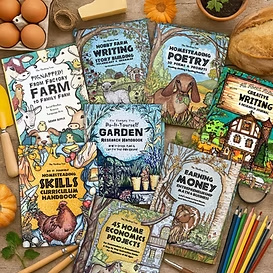
Back to Basics Homesteading & Farm Bundle– Nature study. Essential homestead and farm skills. Handicrafts. Economics. Writing. And more! Some of the journals are available individually as PDFs and all are available individually as Paperbacks as well.

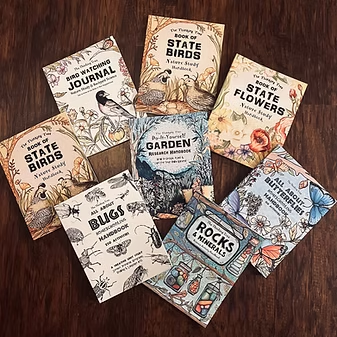
Nature Study & Outdoor Science A Charlotte Mason-inspired nature study journal used by Wild + Free families around the world!

Core Journals– Seasonal core journals to cover all the major school subjects- and nature study in one place. Each has a fun seasonal and nature-inspired theme. Summer. Spring Girls. Spring Boys. Winter Girls. Winter Boys. Autumn.

Wilderness Adventure Handbook Essential wilderness survival skills presented in a fun way. Teaches outdoor safety, survival, wildlife skills, and more. A fun group study.

The Backyard Science Bundle-Our most popular nature study journals all in one bundle. The journals are available individually as PDFs and Paperbacks as well.


Read More-

Budget-Friendly Tips from Real Fun-Schooling Moms!
The Princess of Montgomery Woods
Fun-Schooling Lifestyle, Practical Tips & Reality 

Raising Kids to Cherish—and Steward—Their Freedom

One of our greatest callings as parents is to raise children who can thrive in freedom—not just obey when watched, but walk in wisdom when no one’s looking. It isn’t about raising kids who can put on a perfect performance, turn on good behavior when grandparents are around, avoid punishment, or ace a test. It’s about building character and capacity to steward freedom.

Lots of freedom! In our home, we don’t just teach kids what to think and to blindly obey and comply — we guide them how to think, how to choose, to ask questions and we show them how to recover when choices lead to mistakes. We give them space to try, fail, try again. And we give them freedom to experiment and learn with grace.

When you give a child freedom, you also give them responsibility—and that’s where real learning begins. If a child abuses the freedom, I sometimes have to say “since you are being irresponsible you are obviously not ready for this kind of freedom and responsibility.” And we often have to teach them a lesson by taking away a privilege. Like screen time, or give them the opportunity to fix what they messed up before allowing them to have that level of freedom again. Basically – “Act like a baby and I’ll treat you like one!”

We raise our children with the end in mind: not just graduation, but life. And life begins now! That means letting them practice freedom while we’re still here to catch them, guide them, and love them through the process. Not controlling them—but connecting with them so they learn to govern themselves.

Fun-Schooling isn’t just about flexible academics. It’s about nurturing hearts, creativity, and ownership of learning—so our kids grow up prepared to lead, love, and live well.

The goal isn’t a perfect child. The goal is a thriving, free-thinking human who knows how to learn, choose wisely, and love deeply.

Freedom is a very precious gift, many people around the world do not enjoy the freedom, opportunity, and the justice that is available to those of us celebrating the birth of the United States 🇺🇸– we often forget what freedom cost and we forget how to steward and value this treasure.

In my home, in the way I educate my children and as a citizen of this great country – I feel deeply grateful for freedom, and with it I feel both a deep sense of gratitude and responsibility.

I want to raise children with the same values, and so I teach them by example – the love of liberty and the wise stewardship of it – in every facet of life.

Let’s raise kids who don’t need to escape our rules to find themselves—because they were trusted, respected, and trained in freedom all along.

Why I created Mom School

We all know the saying, “You can’t teach an old dog new tricks.”
Well, that might be true for dogs—but not for moms!

Honestly, I feel like I’m learning something new every single day.
How to be a better mom.
How to plant and tend a vineyard.
How to ride a horse without falling off (still working on that one).
How to nurse a sick chicken back to health.
How to make sourdough that actually rises and kombucha that tastes like something you’d want to drink.
How to explore villages in Europe without getting insanely lost.
How to take better care of myself—body, mind, and spirit.
How to love God more deeply and live each day with intention and joy.

Moms don’t stop learning when we get married or have kids. In fact, motherhood is one of the biggest learning curves of our lives! And somewhere along the way, I realized…
I make all these incredible books for kids—books that help them explore, grow, and fall in love with learning.

So why couldn’t I make something like that… for moms?

That’s when the idea for Mom School was born.
Mom School is a series of creative journals and guided notebooks designed to help moms keep learning, growing, and thriving—right in the middle of everyday life.
It’s for the mom who wants to go deeper in her faith.
The mom who wants to remember what she loves—her interests, her dreams, her goals.
The mom who’s rediscovering what it means to be healthy, creative, and whole again—not just a caretaker, but a woman on a journey.

It’s a space for self-reflection, gratitude, personal growth, and soul care.

Whether you’re in the thick of diaper changes or homeschooling teens… running a farm or running a business… there’s something powerful about opening a book that says, “Hey, you matter too.”

I made this for you.
Because learning doesn’t stop when motherhood starts.
Welcome to Mom School.
Let’s do this together.


PDF Mom School journals here
Paperback Mom School journals here
Mom School bundles here– 20% off with code 20%BundlesJune through June 29, 2025

How to bring more FUN into your Charlotte Mason homeschool

The Charlotte Mason method is among the fastest-growing homeschool methods. With a focus on living books, nature, art, and recognizing the inherent worth of every child, we understand why. There is a lot of beauty to be had in a Charlotte Mason homeschool. It is also true that this method can sometimes feel rigid and overwhelming!

Let’s talk about how to make a Charlotte Mason education fun!!!!

Charlotte Mason Mom School

Yes, we always want to start with you! Mom-School is empowering to you as a woman and sets the stage for your children to follow your example because you make learning look so delightful. Charlotte Mason wanted children to delight in and love learning, and that starts with you setting an example!

The Home Education series by Charlotte Mason is a six-volume series explaining the why and how of her approach. These books cover babies through teens, walking you through every step of the way. They are essential for your Mom School basket if you want to incorporate Charlotte Mason in your home. She addresses and encourages Moms directly throughout the books.

Ms. Mason encourages and reminds us to keep school engaging, varied, and fun. Academic lessons should only take about half the day- yes, even for teens. Leaving lots of time for the children to do what they want to do! Crafts. Play outside. Create. Dream. Rest. You will learn a lot and be encouraged in these books.

You can read Volume 4- Ourselves- when your children are teens. This is when life with your growing kids gets fun! It’s about empowering them to become who they were meant to be, while you give them encouragement, support, and fair discipline. Ourselves will help you guide these conversations and develop their character- and yours.

Making Charlotte Mason Fun!

What I hear most often from Charlotte Mason moms is it’s “too much.” Too many notebooks. Too many narrations. Book lists that are way too long. They love the living books. They love the time outside. They love handicrafts, picture study, and studying the classics. But they struggle to find a balance.

I started out as a Charlotte Mason homeschool mom with some Montessori sprinkled in. Fun-Schooling journals were born because I wanted to include at the riches of this education without searching for individual notebooks. I created the Core Journal so I could take a break from customizing each child’s curriculum around their interest, while making sure we included copywork, nature study, logic, film study, math time.

After a while, I even created a Charlotte Mason-based core journal. Moms and kids loved it. It lets you cover everything you love about Charlotte Mason without switching around to a bunch of different notebooks or telling your kid to move on to the next subject. The journal walks them through it all. It gives them more independence, too.

Make your homeschool work for you. Are the book lists too long? Cut out books your kids (or you) don’t like. Do you struggle to find the time for read-alouds? Use audiobooks. Do you want to do interest-based learning and Charlotte Mason? Let your kids choose the topic & you can help them find living books to study from.

Fun-Schooling journals can let you mix the goodies of a Charlotte Mason education with FUN!

Charlotte Mason Fun-Schooling Journals

All of our journals were created with a love for Charlotte Mason, so you can use any that you and your children like. These are the most popular-

Pondering the Past– copywork from 30 classical works

American History Timeline– part American History book, part Charlotte Mason timeline

World History Timeline– a key part of a C.M. education is a timeline, this lets you easily set one up!

Nature Study & Outdoor Science

Picturing the Past– Picture study

Creative Copywork & Copywork from the Bible


Read more-

Our FREE magazine from Winter 2025 was about all things Fun-Schooling Charlotte Mason
21 Thoughts About Core Journals will help you understand more about these journals that combine all the CM riches in one place
What is Copywork? Will walk you through how to start copywork and why it matters

How a Neuroscience Discovery Sparked Dyslexia Games: A Personal Reflection on Reading in the Brain

Over a decade ago, I stumbled upon a book that changed the course of my family’s journey—and eventually, the lives of tens of thousands of families around the world. That book was Reading in the Brain by neuroscientist Stanislas Dehaene. In it, he explains what happens inside the brain when we read—and what doesn’t happen in the brains of people with dyslexia.

The chapter that stood out to me most as a mother of dyslexic children was the one on dyslexia, but the chapter before it offered a key insight that unlocked everything for me. Dehaene describes the “letterbox” area in the left hemisphere of the brain—the visual word form area—as the hub where reading takes place in a neurotypical brain. But for people with dyslexia, this area is either inactive or extremely slow during reading tasks, which explains their deep struggles with recognizing written language.

But then came the breakthrough: brain scans of dyslexic individuals who eventually learn to read showed something amazing. Instead of the left-side letterbox lighting up, a mirrored area on the right hemisphere becomes active—abundantly active, in fact. The dyslexic brain was not broken; it was finding a new way. The right brain, it turned out, was stepping in to compensate—and succeeding.

When I read that, I felt chills. It confirmed what I had suspected from watching my own children: the right brain holds the key.

So I decided to experiment. I began developing a therapy based on the idea of activating the right side of the dyslexic brain by engaging its natural strengths:

• Visual thinking
• Drawing and pattern recognition
• 3D spatial awareness
• Envisioning
• Creativity
• Intuition
• Holistic problem-solving
• Artistic expression

Instead of forcing phonics drills or repetitive worksheets, I started where the dyslexic brain thrives.

I started creating puzzle games for my nine-year-old daughter, Anna, who couldn’t even read the word “dad”.

I reintroduced literacy slowly—starting with art and logic games that included symbols and simple, visually distinct letters. Then I gradually added more challenging, commonly confused letters (like b/d, m/w p/q, n/u), and eventually moved on to short words, sentences, poetry, reading games, writing activities, and spelling puzzles—all integrated into fun, visual, and logic-based exercises.

This became the foundation of Dyslexia Games.

My theory was simple: If I could light up the right brain through activities it loves, and gently introduce reading within that context, then that hemisphere could actually learn to read. And Dehaene’s research supported this idea. MRI studies showed that when dyslexic people do succeed in reading, it’s not because their brains “fixed” the left side—but because the right hemisphere took over.

Even more fascinating is what Dehaene shares in The Science of Reading: post-mortem studies of dyslexic brains have found bundles of immature neurons in the reading centers of the left hemisphere, likely formed incorrectly in the womb. That’s not something we can fix—but thankfully, the right brain doesn’t have that problem. The amazing human brain reroutes, compensates, and overcomes.

And the results? Children who had once felt broken began reading joyfully—without confusion, frustration, or shame. In just about three months, many of these kids became passionate readers, because they were finally using the part of their brain designed to help them succeed.

We’ve now seen tens of thousands of children overcome reading struggles with this method.

If you’re a parent or teacher of a child with dyslexia, I urge you to read Dehaene’s Reading in the Brain. You’ll find the science that explains what you’ve likely seen with your own eyes. And if you’re ready to try a right-brain approach to literacy, DyslexiaGames.com is here to help you begin that healing journey.

Your child is not broken. Their brain is just wired differently. And that’s not a weakness—it’s a strength waiting to be unlocked.


Learn More


Rodrigo Gains the Childhood He Was Missing Thanks to Dyslexia Games
Dyslexia Games FAQs
Homeschooling a Child with Dyslexia | Tips to Keep it Fun

5 Reasons Why I Deeply Regret Homeschooling…

Here are five reasons why I deeply regret homeschooling my children all these years. For context, I have 15 children ranging in age from 10-26. They have all been homeschooled,

1. Too much socialization. My kids have friends of all ages, each other, youth group, co-ops, and extracurriculars. I was really looking forward to raising socially awkward recluses, but here we are.

2. I never get to wake up at 6 AM. No alarms, no dragging half-asleep kids anywhere, no rushed mornings. I miss the chaos… said no one ever.

3. They don’t know what ‘busy work’ is. They think learning should be fun, meaningful, and based on curiosity. Poor things never experienced filling out 30 pointless worksheets just to pass the time.

4. Learning keeps happening. Even when “school” is over, my kids are still asking questions, researching, and exploring. It turns out curiosity doesn’t clock out at 3 PM. Who knew?

5. I actually enjoy my kids. Turns out, when kids aren’t exhausted from school stress, they’re really fun to be around.

Final verdict: No regrets. Just freedom, flexibility, and a life we actually love.

How about you? What would you add to this list? How do you respond to people who ask if you have regrets about homeschooling?

From Struggling at Public School to Homeschool Success: A Journey to Fun, Creative Learning

Deciding to transition a child from public school to homeschool can be an overwhelming choice for many families. Loving parents want the best education possible for their children. They’ll work to ensure their home is a place of creativity, games, music, art, conversation, and activity. 

Life can be great at home. Your children may be perfectly happy there. Yet they struggle in school. 

Maybe your student quickly became bored and discouraged. 

They get confused by worksheets. Spelling tests, math problems, and sitting at a desk all day are not their idea of fun. Moving from room to room in a perfect line. All the noise in the cafeteria. The sense of losing their freedom, having every minute of the day controlled by someone who barely knows them. 

This was how I felt when I was a little girl. I went to school for the first few years and was miserable there. The thing I liked best each day was watching the big clock in the center of the wall in the front of the classroom when the hour hand pointed to the big three. I also liked the bell that would ring at the end of the school day.

I became a daydreamer. I would doodle on my schoolwork. I would play with my pencils and make origami when the teacher wasn’t looking. I would look out the window and imagine I was somewhere else. 

I felt like school was a waste of time, and I didn’t see why I should have to go. I wasn’t even good at schoolwork; the letters swirled around on the page, and long lists of math facts made me dizzy. 

Does my experience sound like your child? How about any of these-

Signs it might be time to transition from public school to homeschool.

Are your child’s problems at school creating problems at home?
Does your child say they are dumb, lazy, or immature?
Has your child’s self-esteem gone down since starting school?
Are they withdrawing?
Does the teacher say they are distracted, unmotivated, or creating problems?
Is there a chance they might fail the grade they’re currently in?

Making an easy switch!

I took my experiences as an unhappy student and transformed them into a FUN homeschool curriculum. I create curriculum that makes learning the basics really fun! 

I started by creating a series of therapy workbooks that use art and logic to teach reading, writing, and spelling. It’s helped thousands of kids so far. I’m even adding two new books to the series. It was so successful that I created a partner program for math. I’ve made over 300 books and PDFS covering every standard school subject and dozens of extra “special interest” subjects. 

Do you have a struggling learner? Are you thinking about transitioning your student from public school to homeschool? I can help! 

Just ask me anything in the comments and I’ll do my best to share my tips. You can also email or reach out via DM on Facebook or Instagram. Making the switch to homeschooling can be pain-free! .


Learn More

Flip to Fun-Schooling!
Is Fun-Schooling a Full Curriculum?
Sarah’s Mom Tips: Two Questions to Jump Start Your Fun-Schooling

How to Transform Your Homeschool: Perfectionism to Joy

Homeschool moms! Let’s throw our stress overboard! Let’s release the things that cause stress! Let’s set ourselves (and our kids) free from unreasonable and irrational expectations. Somehow, we imagined that these unrealistic goals were the right way.
Untangle yourself and your kids from the things that choke out the joy in learning!
Here’s how:
One of the greatest gifts we can give our children is the ability to take their thoughts captive and release burdens that were never meant to be theirs to carry. As homeschooling parents, we often focus on academic achievement, but if we aren’t careful, we can unintentionally plant seeds of anxiety, perfectionism, and self-doubt in our children’s hearts.
God never intended for us to live weighed down by fear or the need to perform for approval. Matthew 11:28-30 reminds us to come to Jesus for rest, and 2 Corinthians 10:5 tells us to take every thought captive in obedience to Christ. These truths are not just for us as parents—they are essential for our children as they grow into the people God created them to be.
So how do we weave these lessons into our homeschool days?


The Hidden Burden of Traditional Schooling
In many educational settings, children are trained to work for grades, external approval, and the fear of making mistakes. Every assignment is graded, every test has red marks, and progress is often measured by how few errors they make rather than how much they have learned.

When children are constantly evaluated this way, they internalize a dangerous belief: “I am only as good as my ability to get things right.”

This burden is heavy, and I’ve seen how it plays out in adulthood. It creates individuals who are afraid to take risks, explore new ideas, or step into their God-given creativity. Instead of growing into confident problem-solvers, they become people-pleasers, perfectionists, or those who avoid challenges altogether because they fear failure.
When I was young, I struggled with traditional academics. I saw myself as someone who wasn’t smart enough, always focusing on my weaknesses rather than my gifts. I even failed third grade!!!
But when I embraced learning on my own terms (at age 13) following my curiosity, using creativity, and celebrating progress instead of perfection—I discovered a love for learning that has lasted a lifetime. This is the heart of Fun-Schooling.

How Fun-Schooling Releases Burdens
Fun-Schooling is not about performance—it’s about passion, mastery, and lifelong learning. Instead of burdening our children with the fear of failure, we give them the tools to learn with confidence and joy.
In our home and in thousands of Fun-Schooling families, kids don’t study to earn grades or please a teacher. They study to pursue knowledge, build skills, and prepare for the future God has for them.

Traditional school teaches kids to focus on their mistakes.
Fun-Schooling teaches kids to focus on their gifts.

When kids are given the freedom to research, explore, and follow their interests, they become fearless learners. They know that making mistakes isn’t failure—it’s part of the process. Instead of becoming burdened by anxiety, they develop the mental strength, confidence, and peace that are uncommon in traditionally schooled children.

Teaching Kids to Take Thoughts Captive
So how do we practically help our children apply 2 Corinthians 10:5—taking every thought captive—and Matthew 11:28-30—laying down heavy burdens?
Here are a few ways to include character teaching in your homeschool day…

Click here to keep reading!

Fun-Schooling & “The Let Them Theory”: A Perfect Match

As a mother of 15 and the creator of Fun-Schooling, I’ve spent decades helping families embrace a natural, joy-filled approach to learning. Recently, as I’ve been reading The Let Them Theory by Mel Robbins and listening to her podcast, I realized just how deeply her philosophy aligns with what I’ve been teaching through Fun-Schooling for years.

For me it started on the day I woke up, a homeschool mom of eight who was worn out micromanaging their education and depressed because there was no joy. So I said, “Today I will just say YES to whatever they want to do.” I had created a beautiful environment for learning, but curriculum was boring, limiting and too much work for me. I was drained and wanted to enjoy being a mom while homeschooling. I told my kids, “We are going to Fun-School today”. It was amazing. The learning that happened amazed me, and the joy set us all free.

Mel’s Let Them theory is about releasing control, allowing people to make their own choices, and letting go of the urge to micromanage. Fun-Schooling is based on the same principle—letting children study what they love, explore their passions, and skip the boring, outdated schoolwork that kills curiosity. Instead of forcing learning through rigid, one-size-fits-all curriculums, we let kids take the lead, trusting their natural desire to grow, explore, and create.

Here are ten ways Fun-Schooling and The Let Them Theory are a perfect match:

Let Them Learn What Excites Them

Mel Robbins encourages us to let people pursue their own interests, even if we don’t understand them. Fun-Schooling follows this same logic: if a child is obsessed with horses, let them dive deep into everything horse-related—biology, history, art, business, and storytelling—all through their passion.

Let Them Skip the Boring Stuff

Traditional education forces kids to memorize facts they’ll never use, leading to burnout and frustration. But what if we let them skip what doesn’t spark their curiosity? In Fun-Schooling, we trust that when a child is deeply engaged, they’ll develop the skills they need naturally.

Let Them Make Mistakes

Mel emphasizes that people learn best through their own experiences. Fun-Schooling embraces this truth—kids don’t need to get everything “right” the first time. They need freedom to experiment, fail, and try again without fear of judgment.

Let Them Go at Their Own Pace

Not every child learns on the same timeline, just like adults don’t all hit milestones at the same time. Fun-Schooling allows kids to develop skills when they’re ready, not when a curriculum says they should.

Let Them Create Instead of Conform

Mel Robbins challenges us to step away from people-pleasing and embrace individuality. Fun-Schooling does the same by giving kids the space to create, imagine, and build rather than just regurgitate facts.

Let Them Follow Their Curiosity

We trust that adults will figure things out when they’re interested in something—why don’t we extend that same trust to children? Fun-Schooling encourages kids to chase their curiosity, knowing that a self-motivated learner will always go further than a forced one.

Continue reading by clicking here.